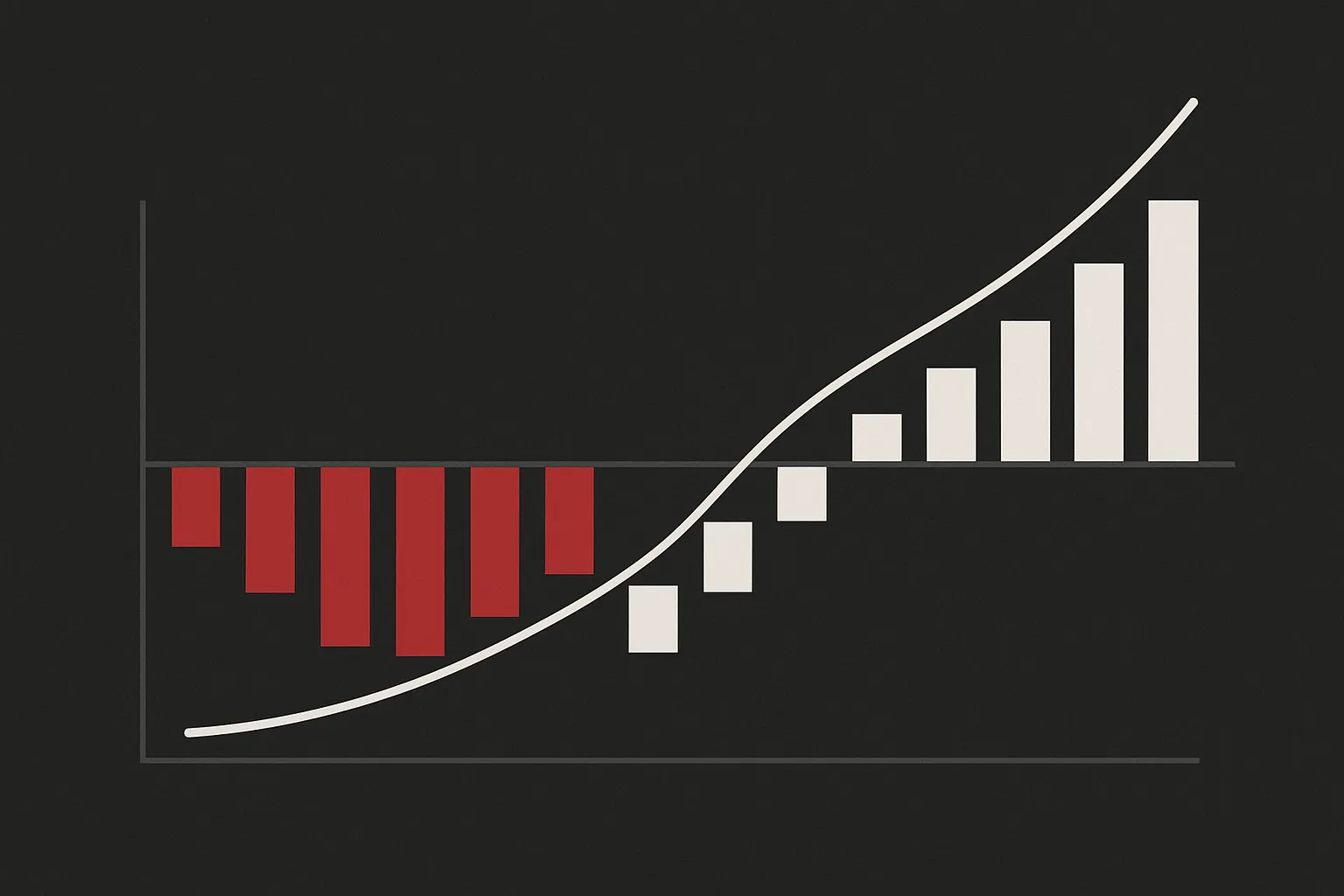
The Working Capital Runway: Cash Flow Modeling from Signing Day Through Break-Even
The franchise fee, build-out, and SBA loan are the costs everyone models. The 10 months of negative cash flow after opening is the cost that actually kills studios.
Every Hotworx cost analysis starts with Item 7 of the Franchise Disclosure Document. Total estimated initial investment: $156,780 to $407,200. Working capital: $35,500 to $54,500.
Those numbers answer the wrong question.
The right question isn’t “how much does it cost to open?” It’s “how long can I survive losing money every month before enough members walk through the door?”
That gap — between opening day and monthly break-even — is where franchise failures happen. Not because the concept doesn’t work, but because the franchisee’s cash reserve empties before the revenue curve catches up to the cost line.
This piece models exactly that: the month-by-month cash burn from the day you sign the franchise agreement through the month your studio generates positive cash flow. Three scenarios. Real numbers. No promotional optimism.
The Gap Between ‘Total Investment’ and ‘What You Actually Need’
The FDD’s working capital range of $35,500 to $54,500 covers three months of operating expenses at the low end of the cost structure. For a studio with $8,000/month rent in a competitive market, that’s barely two months.
Here’s what the FDD working capital figure assumes:
- What it covers: Rent, utilities, payroll, insurance, and basic marketing for the initial operating period
- What it doesn’t cover: The 6–12 months of cumulative operating losses before revenue exceeds costs
- What it definitely doesn’t cover: The personal living expenses you still need to pay while the studio bleeds cash
The distinction matters because “total investment” includes everything you need to open. What you need to survive is a different — and larger — number.
Franchisors don’t overstate working capital requirements because doing so would increase the total investment figure, potentially scaring off candidates. This isn’t deception. It’s adverse selection math: higher disclosed costs mean fewer applicants. But it means you, the prospective franchisee, need to model the actual capital requirement independently.
Month-by-Month Cash Flow Model: Three Scenarios
The following model uses Hotworx’s disclosed average revenue of $330,476 at maturity, the hidden monthly operating costs we’ve detailed previously, and realistic member acquisition curves based on boutique fitness industry benchmarks.
Fixed Monthly Costs (All Scenarios)
| Line Item | Low | High |
|---|---|---|
| Rent + CAM | $4,000 | $8,000 |
| SBA loan payment | $2,500 | $3,500 |
| Staff (manager + PT) | $3,000 | $5,000 |
| Royalty (flat) | $595 | $595 |
| Utilities (infrared = high electric) | $1,500 | $2,500 |
| Insurance | $200 | $400 |
| Marketing (mandatory + local) | $1,500 | $2,500 |
| Tech/POS/software | $300 | $500 |
| Total fixed monthly | $13,595 | $22,995 |
Using a midpoint of $18,000/month in fixed costs and average membership revenue of $59/month per member:
Conservative Scenario: Weak Pre-Sale
- Founding members: 80
- Monthly organic growth: 15 new members
- Monthly attrition: 8%
- Break-even point: Month 13–14
- Cumulative cash burn before break-even: $95,000–$120,000
- Total capital needed beyond initial investment: $130,000–$160,000 (including safety buffer)
Base Case Scenario: Solid Pre-Sale
- Founding members: 150
- Monthly organic growth: 25 new members
- Monthly attrition: 6%
- Break-even point: Month 7–9
- Cumulative cash burn before break-even: $45,000–$65,000
- Total capital needed beyond initial investment: $70,000–$95,000 (including safety buffer)
Optimistic Scenario: Exceptional Pre-Sale
- Founding members: 250+
- Monthly organic growth: 30+ new members
- Monthly attrition: 5%
- Break-even point: Month 4–5
- Cumulative cash burn before break-even: $15,000–$25,000
- Total capital needed beyond initial investment: $35,000–$55,000 (including safety buffer)
The gap between the conservative and optimistic scenarios is roughly $100,000 in required capital. That’s the pre-sale premium — the financial difference between a well-executed launch and a poorly-executed one.
The Pre-Sale Variable: Why Your First Day Determines Your Runway
Your pre-sale execution is the single biggest variable in your cash flow model. The founding member count on opening day determines how deep the initial cash burn goes and how long it lasts.
Why Founding Members Matter More Than Monthly Growth
- 150 founding members at $59/month = $8,850/month in recurring revenue from Day 1
- 80 founding members = $4,720/month — a $4,130/month revenue gap that compounds every month it takes to close
But not all founding members stick. Industry data shows 15–25% of founding members cancel within the first 90 days. Some signed up during the promotional pre-sale pricing period and leave when rates normalize. Others were curious but not committed.
The attrition adjustment: If you sign 150 founding members and lose 20% in the first quarter, you’re operating at 120 members by month 4. Your cash flow model needs to account for this drop, not just the opening number.
Model your pre-sale outcome at 70% of your target, not 100%. If the model still works at 70%, your runway is sufficient.
When the Reserve Hits Zero: The Three Paths Forward
Every franchise that runs out of working capital faces three choices. None of them are good.
Path 1: Personal Capital Injection
The most common path. You dip into personal savings, a home equity line of credit, or a retirement account to keep the studio alive. This is the investment the FDD never discloses because it’s not part of the franchise system — it’s the franchisee bailing out their own business.
According to SBA data, small businesses that require unplanned capital injections within the first year have a 40% higher failure rate by year three. Not because the injection fails, but because the conditions that caused the cash shortfall often persist.
Path 2: SBA Working Capital Line of Credit
In theory, an SBA line of credit can bridge the gap. In practice, getting approved for additional SBA financing while your existing SBA loan is on a business that isn’t yet profitable is exceptionally difficult. Lenders see a studio losing money monthly and a borrower asking for more money — that’s not a lending opportunity, that’s a risk signal.
If you’re going to need a working capital line, build it into your original financing package. Lendesca can help you understand how to structure an SBA loan request that accounts for realistic working capital needs — not just the franchise fee and build-out costs, but the full runway to break-even.
Path 3: The Cash Flow Death Spiral
The worst outcome, and the most predictable: you cut marketing spend to conserve cash. Marketing is the easiest line item to reduce because there’s no immediate consequence — no vendor calling, no employee quitting, no landlord threatening. But reduced marketing means fewer new members, which means slower revenue growth, which extends the break-even timeline, which burns more cash. The spiral accelerates because the fix (spending on growth) and the symptom (running out of cash) require opposite actions.
The Capital Reserve Calculator: How Much You Actually Need

Here’s the formula:
Required reserve = (Monthly fixed costs × Months to break-even) − (Projected cumulative revenue during ramp) + (3-month safety buffer)
Using base case numbers:
- Monthly fixed costs: $18,000
- Months to break-even: 8
- Projected revenue during ramp: ~$82,000 (cumulative, growing monthly)
- 3-month safety buffer: $54,000
Required reserve = ($144,000) − ($82,000) + ($54,000) = $116,000
That’s $116,000 in liquid capital beyond the total initial investment. Not in home equity. Not in retirement accounts you can’t access for 60 days. Liquid — in a checking account or a line of credit you can draw on today.
The realistic range, depending on your market and pre-sale outcome: $70,000 to $160,000 in accessible capital beyond the initial franchise investment.
How to Build This Into Your Plan
- Start with the worst case. Model the conservative scenario first. If you can survive 14 months of negative cash flow, every other scenario is upside.
- Include personal living expenses. If the operating partner is leaving a W-2 job, their salary replacement for 12 months is part of the capital requirement. That’s another $50,000–$100,000 depending on your household.
- Build the reserve into your SBA request. SBA 7(a) loans can include working capital. A well-structured loan request that shows realistic cash flow projections — including the break-even timeline — is more likely to get approved than one that pretends the studio will be profitable from month one.
- Use SCORE’s financial projections template as a starting framework. Customize it with the Hotworx-specific cost structure and revenue model from our unit economics analysis.
The Bottom Line
The franchise fee is the price of admission. The build-out is the price of opening. The working capital runway is the price of surviving. Most Hotworx cost analyses cover the first two. This one covers the third — because it’s the one that determines whether you’re still operating in month 14.
Every prospective franchisee should be able to answer one question before signing: how many months can I lose money before I run out of options? If the answer is less than 12, your capital plan isn’t finished.
This analysis is for informational purposes and does not constitute financial advice. Revenue projections and cost estimates are based on publicly available FDD data and industry benchmarks — actual results vary by market, operator, and timing. For our editorial standards and data sources, see our About page.