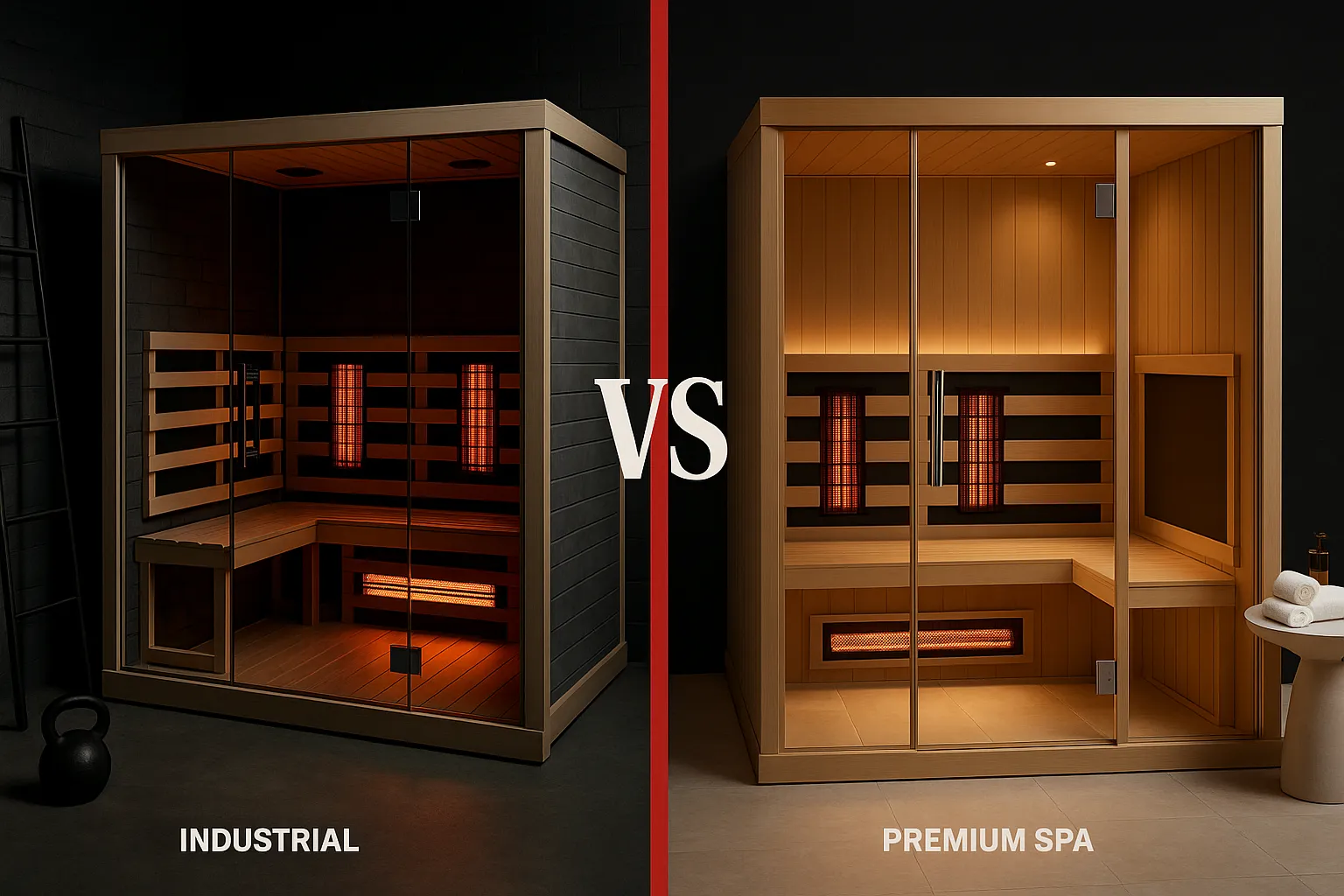
Hotworx vs. Perspire Sauna Studio: Two Bets on Infrared — One Investment Decision
Same technology, radically different business models. One costs half as much and has 10x the locations. The other charges more and positions as premium wellness. Here’s how to think about the choice.
Introduction
If you’ve decided that infrared is the future of boutique fitness, your real decision isn’t whether to invest — it’s which version of the infrared thesis you believe in.
Hotworx and Perspire Sauna Studio are the two franchised bets on infrared technology, and they’ve made almost completely opposite strategic choices about how to build a business around it. Different price points, different positioning, different unit economics, different growth strategies. Comparing them isn’t about which is “better” — it’s about which model matches your capital, your risk tolerance, and your view of where the wellness market is heading.
The Numbers Side by Side
| Metric | Hotworx | Perspire Sauna Studio |
|---|---|---|
| Initial investment | $258,550–$359,212 | $566,000–$990,000 |
| Franchise fee | $24,990 | $50,000 |
| Royalty | $595/month flat | 7% of gross revenue |
| Ad/marketing fee | 2% national marketing fund | 2% of gross revenue |
| Open locations | 800+ | ~72 (66 franchised + 6 corporate) |
| Licenses awarded | Not disclosed | 250+ |
| Estimated AUV | ~$330,000 (FDD Item 19) | ~$526,000 (analyst estimate) |
| Positioning | Infrared fitness (workout-focused) | Infrared wellness (recovery/spa-focused) |
| Model | 24/7 virtual instruction | Appointment-based private suites |
| Studio size | 1,200–1,500 sq ft | 1,500–2,500 sq ft |
| Founded | 2017 | 2010 |
| Franchise 500 rank | #58 (2026) | Not ranked |
The investment gap is the first thing you notice. Hotworx costs roughly half what Perspire costs at the low end, and less than 40% at the high end. But the revenue gap partially closes that: Perspire’s estimated $526K AUV versus Hotworx’s $330K.
Positioning: Fitness vs. Wellness
This is the strategic fork that explains almost every other difference.
Hotworx chose fitness. The product is a workout — 30-minute isometric sessions (yoga, Pilates, barre) and 15-minute HIIT sessions (cycling, rowing) inside infrared saunas. The value proposition is time efficiency: a compressed, intense workout in a heated environment. Members come to exercise, not to relax.
Perspire chose wellness. The product is a recovery and relaxation experience — private suites with entertainment systems, personal showers, and pre-set member preferences. The value proposition is therapeutic: infrared therapy, red-light therapy, contrast therapy, and halotherapy combined in one studio. Members come to recover, destress, and treat their bodies.
This positioning difference cascades into every operational decision:
- Staffing: Hotworx needs minimal staff thanks to virtual instruction. Perspire requires more hands-on service delivery.
- Real estate: Hotworx fits into smaller, more affordable spaces. Perspire needs larger suites with higher build-out costs.
- Member experience: Hotworx competes on convenience and price. Perspire competes on exclusivity and experience quality.
- Revenue per member: Perspire can charge premium pricing for a spa-like experience. Hotworx prices competitively against traditional boutique fitness.
The Royalty Math: Flat vs. Percentage
This is the single most important financial difference, and it compounds over time.
Hotworx charges a flat $595/month regardless of revenue. At $330K annual gross, that’s an effective royalty rate of 2.2%. At $500K, it drops to 1.4%. The more you earn, the less the royalty hurts — a powerful incentive for high-performing studios.
Perspire charges 7% of gross revenue. At their estimated $526K AUV, that’s $36,820/year — versus Hotworx’s $7,140. The gap is $29,680 annually.
But flip the scenario: a struggling studio doing $15K/month in revenue. Hotworx still charges $595 (4.8% effective rate). Perspire charges $1,050 (7%). Hotworx is cheaper in absolute terms but takes a bigger proportional bite during a cash-flow crisis than you might expect from a “flat fee.”
Over a 10-year franchise term:
| Revenue scenario | Hotworx total royalty | Perspire total royalty | Difference |
|---|---|---|---|
| $250K/year | $71,400 | $175,000 | $103,600 saved with Hotworx |
| $330K/year | $71,400 | $231,000 | $159,600 saved with Hotworx |
| $526K/year | $71,400 | $368,200 | $296,800 saved with Hotworx |
The flat royalty is Hotworx’s most compelling financial advantage. For a high-revenue studio, it’s worth six figures over the life of the agreement.
Scale: 800 vs. 72
Hotworx has 11x more open locations than Perspire. What does that mean for a prospective franchisee?
Brand recognition. Hotworx has broader market awareness. In most metros, potential members have seen a Hotworx studio or know someone who goes. Perspire is still unknown outside a handful of markets.
Operational playbook. With 800+ data points, Hotworx has refined its opening process, site selection criteria, marketing templates, and operational systems far more than a 72-unit system can. When something goes wrong, Hotworx has probably seen it before.
Territory availability. Hotworx’s larger footprint means more markets are claimed. Perspire has vastly more open territory, which is either an opportunity (first-mover advantage) or a risk (unproven in your specific market). And neither are the only infrared options — see our full infrared competitive landscape for the brands most analyses miss.
Resale market. More Hotworx units means more secondary market activity. Franchise resale platforms actively list Hotworx studios. Perspire’s resale market barely exists yet, which affects your exit strategy timeline.
Growth Trajectories
Hotworx is scaling globally — Mexico master agreement for 200+ studios, presence in Canada, Dubai, Saudi Arabia, Ireland, and a target of 1,000 global locations by end of 2026. This is aggressive, established-brand expansion.
Perspire is in a different stage — accelerating domestic growth with multi-unit agreements in five states (CT, NY, FL, CA, VA), 15 new studios planned, and a 500-location target by 2027. Growth rate is high (+154% in franchisee expansion) but from a small base.

The bull case for each:
- Hotworx: proven system, scale advantages, flat royalty rewards growth, first-mover in infrared fitness
- Perspire: premium positioning in exploding wellness market, higher AUV potential, earlier-stage means more territory and potentially better terms
The bear case for each:
- Hotworx: franchisor financial health concerns (reported deficit), rapid expansion could dilute support quality, fitness positioning faces more direct competition
- Perspire: thin operating history, -7.6% revenue trend, $566K+ investment requires either significant liquid capital or aggressive SBA financing, limited franchisee validation pool
The Revenue Trend Warning
Perspire’s reported -7.6% year-over-year revenue trend deserves attention. A wellness brand in an expanding market that’s showing declining revenue per unit could indicate:
- Cannibalization from rapid unit growth in overlapping markets
- Softening consumer demand for premium wellness services
- Execution challenges at the unit level as the system scales
- Normal statistical noise from a small sample (72 units)
With only 72 units, a handful of underperformers can significantly skew the system average. Still — declining revenue during a growth phase is not a data point you should ignore when comparing to Hotworx’s $330K average, which covers a much larger and more stable dataset.
Who Should Choose Which
Hotworx makes more sense if you:
- Have $100K–$200K in accessible capital and want to minimize initial investment risk
- Are evaluating semi-absentee ownership — the lean model supports it structurally
- Prioritize proven systems with extensive operational data
- Want the flat royalty advantage to maximize cash flow as revenue grows
- Are comfortable with a fitness positioning that competes against OTF, F45, and traditional gyms
Perspire makes more sense if you:
- Have $250K+ in liquid capital and higher risk tolerance
- Believe the wellness/recovery market has more growth runway than fitness
- Want first-mover advantage in an underpenetrated market
- Are willing to invest in a smaller, earlier-stage system with less operational proof
- Prefer a premium, appointment-based model over 24/7 self-service
This analysis uses publicly available FDD data, industry reports, and disclosed financial information. It does not constitute investment advice. Consult a franchise attorney and financial advisor before signing any franchise agreement.