The True Total Cost of a Hotworx Franchise: What Item 7 Doesn’t Tell You
The FDD gives you a range. Your bank account needs an exact number. Here’s how to find it.
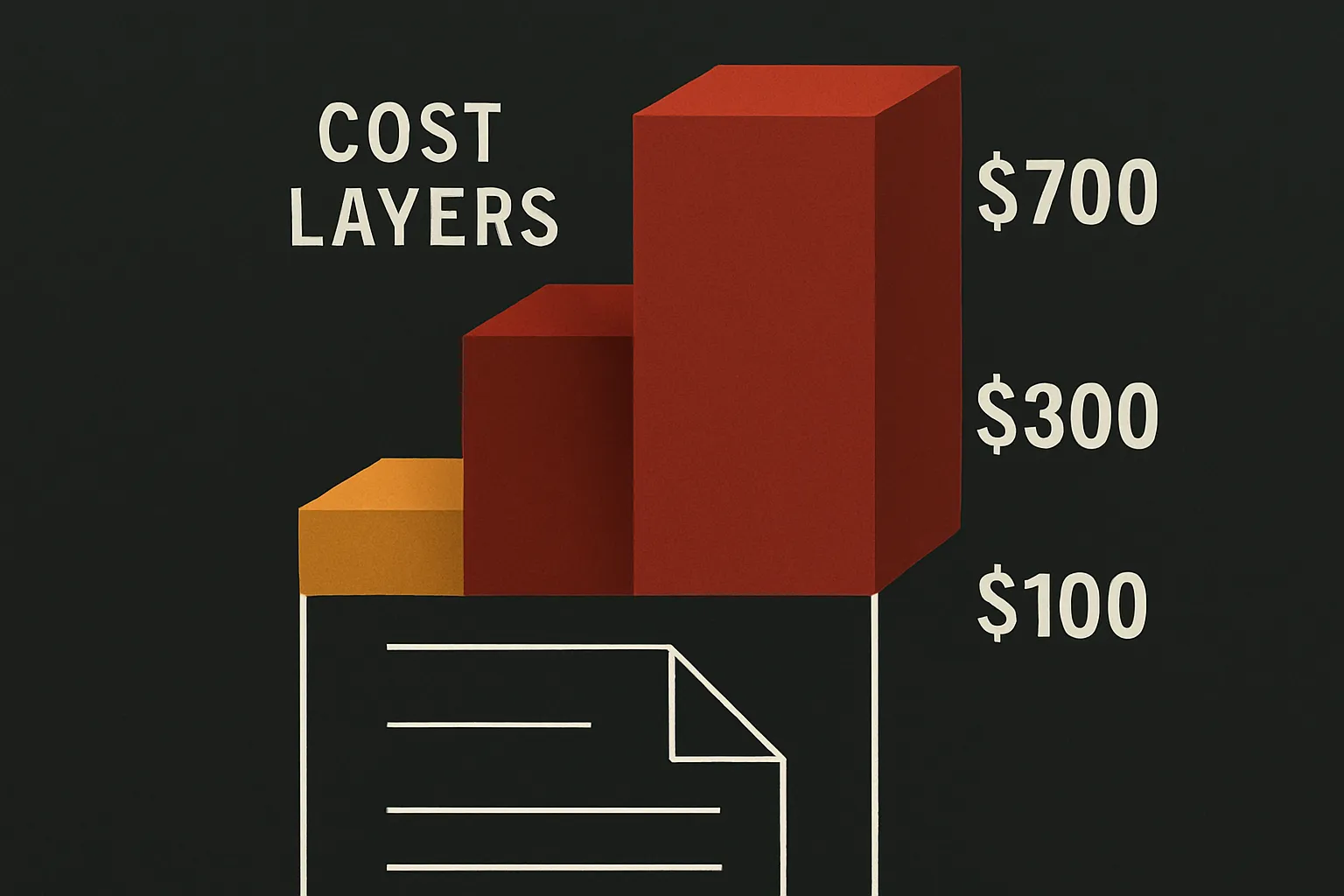
The Hotworx FDD lists an initial investment range of $252,440 to $1,181,200. If you are building a personal capital plan around that number alone, you are underestimating the check you need to write by $30,000 to $75,000 or more.
Item 7 is a regulatory disclosure, not a financial plan. It covers what the franchisor is required to disclose under the FTC Franchise Rule. It does not cover what it actually costs to go from “I signed the franchise agreement” to “the doors are open and I can pay my mortgage.” This piece closes that gap.
What Item 7 Actually Covers
The Hotworx FDD’s estimated initial investment table includes the following core line items:
- Franchise fee: $19,950 (fixed, non-negotiable, non-refundable)
- Leasehold improvements and buildout: The single biggest variable. Ranges from roughly $80,000 to over $500,000 depending on geography, site condition, and landlord contribution.
- Equipment and infrared sauna units: Proprietary Hotworx equipment, purchased through approved vendors.
- Signage: Interior and exterior, subject to local permitting costs.
- Initial marketing/advertising: A required spend for pre-opening and launch promotion.
- SAIL POS system and technology: The proprietary point-of-sale and access system.
- Working capital: A 3-month estimate for initial operating shortfalls.
Why the range is so wide. The $252K–$1.18M spread exists almost entirely because of real estate and construction variables. A second-generation fitness space in a low-cost-of-living market with a generous tenant improvement allowance hits the low end. A ground-up buildout in a Class A suburban retail center in the Northeast or West Coast pushes the high end. The franchise fee, equipment, and technology costs are relatively fixed. Everything else is geography-dependent.
Each line item in Item 7 represents the franchisor’s estimate based on franchisee-reported data and vendor quotes. These are not guarantees. They are ranges, and the actual number depends on your specific site, market, and negotiation leverage with contractors and landlords.
The Costs Item 7 Doesn’t Include
This is where financial plans fall apart. Item 7 is not designed to capture the full cost of becoming a franchise owner. The following expenses are real, unavoidable, and absent from the disclosure.
Professional Services
- Franchise attorney FDD review: $3,000–$10,000. A qualified franchise attorney reviews the FDD, flags risk provisions in the franchise agreement (non-compete scope, termination triggers, transfer restrictions), and may negotiate amendments. Skipping this is a six-figure mistake waiting to happen.
- CPA/accountant for entity setup and financial projections: $1,500–$5,000. Entity formation (LLC or S-corp), EIN registration, chart of accounts, pro forma financial modeling, and tax election strategy. If you are using SBA financing, your lender will require projections — your CPA builds those.
Travel
- Discovery Day travel (Baton Rouge, LA): $1,000–$2,500 per trip. Flights, hotel, meals, and ground transportation. Some candidates visit twice. Hotworx headquarters is in Baton Rouge — budget accordingly based on your departure city.
- Training travel and lodging (2+ weeks): $3,000–$6,000. Hotworx requires multi-week training. Depending on format and location, this means airfare, extended-stay hotel or Airbnb, and daily living costs away from home.
Pre-Opening Living Expenses
- Personal living expenses during buildout: $15,000–$40,000+. This is the line item nobody talks about. Hotworx buildouts typically run 4–8 months from lease signing to doors open. During that period, you are generating zero revenue. If you left a W-2 job or reduced your hours to manage the buildout, you need to cover your mortgage, health insurance, car payments, and family expenses from savings or a personal runway fund. The actual number depends entirely on your current obligations and income replacement needs.
Insurance and Compliance
- Insurance deposits and first-year premiums: Item 7 includes a general insurance estimate, but actual premiums vary significantly by state, coverage limits, and carrier. Expect deposits and first-year premiums to exceed the FDD line item by $2,000–$8,000, particularly for general liability, professional liability, workers’ compensation, and property coverage in higher-risk markets.
Technology Beyond the POS
- Merchant processing setup: Credit card processing fees and setup costs outside the SAIL system.
- Accounting software: QuickBooks or equivalent, typically $500–$1,500/year.
- Payroll system: Gusto, ADP, or similar — $1,000–$3,000/year depending on employee count.
- Security and camera systems: If not included in the buildout scope, $2,000–$5,000.
Marketing Beyond the FDD Line Item
- Grand opening marketing overage: The FDD includes a marketing line item, but competitive markets often require additional spend — local influencer partnerships, paid social campaigns, direct mail, community event sponsorships. Budget an additional $3,000–$10,000 beyond the disclosed amount if you want a strong launch.
Contingency
- Contingency buffer (industry standard: 10–20% of total investment): On a $400K mid-range buildout, that is $40,000–$80,000 held in reserve. This is not optional. Construction delays, permit issues, supply chain problems, and unexpected code compliance requirements are the norm in commercial buildouts, not the exception.
The All-In Number
Here is what the total capital picture looks like when you add the undisclosed costs to the FDD range:
| Cost Category | Low Estimate | High Estimate |
|---|---|---|
| Item 7 initial investment | $252,440 | $1,181,200 |
| Franchise attorney | $3,000 | $10,000 |
| CPA/entity setup | $1,500 | $5,000 |
| Discovery Day travel | $1,000 | $2,500 |
| Training travel/lodging | $3,000 | $6,000 |
| Pre-opening living expenses | $15,000 | $40,000 |
| Insurance overage | $2,000 | $8,000 |
| Technology (non-POS) | $1,500 | $5,000 |
| Grand opening marketing overage | $3,000 | $10,000 |
| Contingency (10–20%) | $25,000 | $80,000 |
| Total all-in estimate | ~$307,440 | ~$1,347,700 |
For a realistic mid-range buildout scenario — a single unit in a moderate-cost market with a reasonable tenant improvement allowance — expect to need $350,000–$500,000 in total capital to get from signed agreement to stabilized operations. That is meaningfully higher than the $252K minimum that anchors most early-stage financial conversations.
This total includes both invested capital and liquid reserves. Not all of it is spent at signing. But all of it needs to be accessible.
If you are financing a portion of the investment, platforms like Lendesca help franchise buyers map their total capital needs against available financing options, including SBA 7(a) loans — the most common vehicle for franchise acquisitions. Our SBA 7(a) financing guide breaks down the current program structure and qualification requirements.
Why the Low End of Item 7 Is Almost Certainly Not Your Number
The $252,440 minimum in Item 7 is a mathematical floor, not a planning target. Here is why it almost never reflects reality:
Construction costs vary dramatically by market. A buildout that costs $120/sq ft in Baton Rouge might cost $180–$250/sq ft in Denver, Phoenix, or suburban New Jersey. The FDD range captures this spread in theory, but prospective franchisees tend to anchor on the low number.
Leasehold improvement ranges assume best-case site conditions. A second-generation fitness or retail space with existing HVAC, plumbing, and electrical infrastructure costs far less to convert than a raw shell. Most available sites fall somewhere in between — and “somewhere in between” is not the low end of the range.
The franchise fee is the only truly fixed cost. At $19,950, it is the same whether you build in rural Alabama or downtown Austin. Everything else — construction, rent, insurance, labor, marketing — scales with your local market. The unit economics model for your specific territory should reflect these local inputs.
Working capital estimates in FDDs are structurally conservative. Franchisors disclose 3-month working capital estimates. Many studios take 6–12 months to reach cash-flow breakeven. The monthly operating costs after opening are a separate analysis — but the gap between 3-month and 12-month working capital needs can be $20,000–$60,000.
Review the Item 19 revenue analysis alongside your cost model. Revenue ramp timing directly affects how much working capital you actually burn before the studio sustains itself.
How to Build Your Personal Cost Model

Do not sign a franchise agreement until you have built a personal cost model that reflects your specific situation. Here is the process.
1. Get Three Contractor Bids Before You Commit
Identify 2–3 commercial general contractors in your target market who have built out fitness or wellness spaces. Provide them with the Hotworx design specifications and your prospective site details. Get written estimates — not verbal ballparks.
The spread between bids will tell you more about your actual buildout cost than any FDD line item. If all three bids cluster around $300K and the FDD low end assumes $150K, you have your answer.
2. Price Your Local Commercial Real Estate
Talk to a commercial real estate broker who specializes in retail leasing in your target trade area. Understand the per-square-foot lease rate, CAM charges, tenant improvement allowances, and lease term expectations. Your occupancy cost is likely the single largest variable in your P&L — and it is not standardized across markets.
3. Call Your Insurance Broker
Get actual quotes for general liability, professional liability, property, workers’ compensation, and business interruption coverage. Provide the broker with the Hotworx concept details, your expected square footage, and employee count. Compare the quoted premiums to the FDD’s insurance line item estimate.
4. Calculate Your Personal Runway
How many months of personal expenses can you cover with zero business income? Be honest. Include mortgage or rent, health insurance (especially if you are leaving employer coverage), car payments, childcare, food, and discretionary commitments. Multiply your monthly burn by 8–12 months. That is your personal runway number — and it is entirely separate from the business investment.
5. Add Your Contingency
Take your total estimated investment — including all the costs above — and add 15%. That is your minimum capital requirement. If that number exceeds your available resources (liquid savings plus approved financing), you need to either adjust your site strategy, negotiate harder on the lease, or wait until your capital position improves.
6. Stress-Test Against Revenue Projections
Build a month-by-month cash flow model for the first 18 months. Use conservative membership ramp assumptions — not the franchisor’s best-case scenario. The independent cost analysis from FranchisePayback and 1851 Franchise’s cost breakdown provide third-party data points to benchmark against.
Your financial model should be built before you commit, not after. The franchise agreement is a binding legal document. The time to discover you are undercapitalized is during the modeling phase — not during month four of a buildout with a signed lease and a depleted savings account.
For more on Hotworx franchise economics and financing, see our Financing section.
This analysis is based on publicly available FDD data and independent research. Hotworx Franchise Intel is not affiliated with, endorsed by, or sponsored by HOTWORX or its parent company. For our editorial standards and data sources, see our About page.