
The Semi-Absentee Promise: What Running a Hotworx Studio Actually Looks Like When You Keep Your Day Job
Virtual instructors and 24/7 access make the pitch easy. The operational reality is more nuanced than any franchise brochure admits.
Introduction
Hotworx’s pitch to the semi-absentee investor is elegant: virtual instructors run the workouts, the studio operates 24/7 without class schedules, and staffing needs are minimal. You keep your W-2 while building equity in a fitness concept that runs itself.
It’s not a lie. But it’s not the whole story either.
The gap between “semi-absentee capable” and “successfully semi-absentee” is where franchisees either build a real asset or hemorrhage money while their attention is elsewhere. If you’re evaluating Hotworx with the intent to keep your current income while your studio ramps up — and that describes most prospects with $150K–$400K in accessible capital — you need to understand exactly what “semi-absentee” demands in practice.
What “Semi-Absentee” Actually Means in Franchise Law
The term has no legal definition. The International Franchise Association doesn’t standardize it. When Hotworx or any franchisor describes their model as semi-absentee friendly, they’re making a marketing claim, not a contractual guarantee.
In practice, franchise consultants define semi-absentee ownership as:
- 10–20 hours per week of owner involvement
- A hired manager runs daily operations
- The owner handles strategic decisions, financial oversight, and staff management
- The owner is not physically present during most operating hours
Compare this to owner-operator models (40–50+ hours) and fully absentee models (under 5 hours, typically multi-unit operators with dedicated management companies). Hotworx sits in the semi-absentee range, but your actual hours depend entirely on your manager, your market, and your willingness to build systems.
The Three Phases of Semi-Absentee Ownership
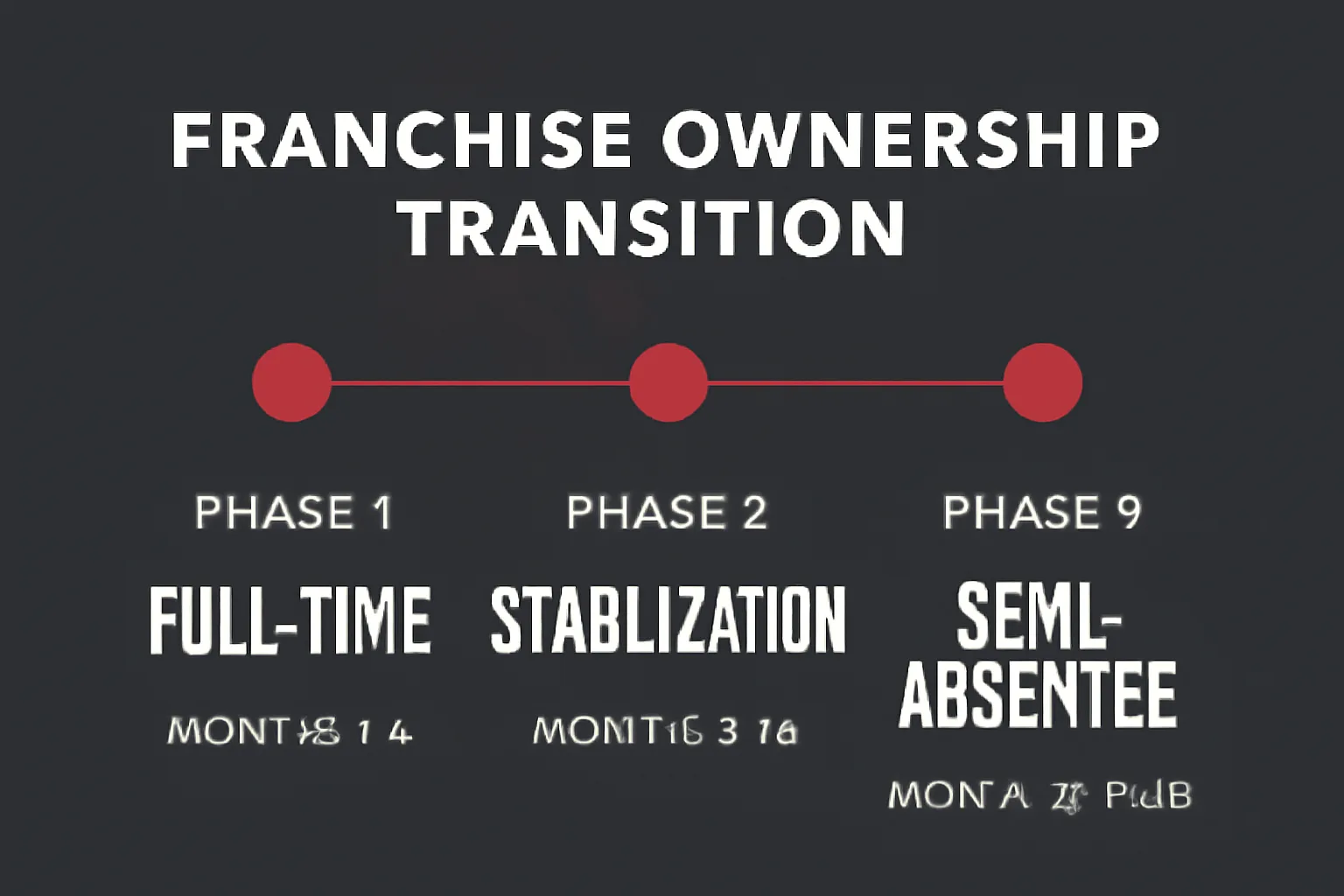
Phase 1: Pre-Opening and Launch (Months 1–4) — Full-Time Required
There is no semi-absentee version of opening a Hotworx studio. During build-out, equipment installation, pre-sale campaigns, and your grand opening period, expect 40+ hours per week of owner involvement.
Key time commitments:
- Real estate and lease negotiation — 20–60 hours over 2–3 months, often during business hours
- Build-out supervision — contractor coordination, permit inspections, equipment delivery
- Pre-sale member acquisition — Hotworx targets 200–350 presale members before launch. You’re the face of that campaign.
- Hiring and training your first staff — even a lean model needs 2–3 reliable front-desk associates
- SocialMadeSimple onboarding — the mandatory social media marketing platform requires setup and content coordination
If you’re keeping your day job during this phase, expect sleep deprivation. Most successful semi-absentee franchisees take 2–4 weeks of PTO for the launch window.
Phase 2: Stabilization (Months 5–12) — 20–30 Hours Per Week
Your studio is open. Members are joining. Things are breaking.
This is the phase that determines whether semi-absentee actually works for you. Common owner tasks during stabilization:
- Manager oversight — weekly 1:1s, reviewing daily reports, handling escalations
- Financial review — monitoring monthly P&L against your projections, tracking member acquisition cost, watching cash reserves
- Member issue resolution — complaints about sauna temperature, billing disputes, facility cleanliness. Your manager handles most of these, but the hard ones land on you.
- Equipment monitoring — infrared saunas, virtual instruction screens, and HVAC systems handling extreme heat loads require attention. Something will malfunction monthly.
- Marketing decisions — approving SocialMadeSimple content, evaluating local advertising spend, deciding on promotional offers
The critical variable: your general manager’s competence. A strong GM reduces your weekly involvement to 15 hours. A weak GM means you’re effectively an owner-operator who happens to also have another job.
Phase 3: Mature Operation (Month 13+) — 10–15 Hours Per Week
If you’ve hired well, built reliable systems, and your studio has hit sustainable membership levels, you can genuinely operate in semi-absentee mode. This looks like:
- 2–3 hours of financial review per week — P&L, bank reconciliation, KPI dashboard
- 1-hour weekly manager meeting — either in-person or video
- 2–3 hours of administrative work — vendor invoices, insurance renewals, lease correspondence
- 2–4 hours of reactive management — staff call-outs, equipment failures, member escalations
- Periodic strategic work — quarterly marketing reviews, annual business planning, community partnerships
This is real semi-absentee ownership. It’s possible. But it takes 12+ months to reach, and not everyone gets there.
What Breaks When You’re Not There
The franchise brochure emphasizes what the virtual instruction model eliminates: personal trainers, class scheduling, instructor no-shows. That’s real. But here’s what it doesn’t eliminate:
Staffing crises. Your front-desk associate calls in sick at 6 AM. Your manager is on vacation. The studio needs someone to handle member check-ins, tour walk-ins, and facility issues. If you don’t have a backup plan, you’re driving to the studio in your work clothes.
Equipment failures at 2 AM. A 24/7 studio means problems happen at every hour. A sauna overheating, a plumbing issue, or a security alarm triggers an immediate response need. You need a protocol for after-hours emergencies that doesn’t always route to your personal phone.
Member safety incidents. Infrared sauna sessions involve extreme heat. A member who passes out, has a heat-related medical event, or injures themselves during an unstaffed overnight hour creates a liability and operational crisis. Your waiver provides legal protection, but the operational response still requires owner-level judgment.
Revenue decline you don’t notice. Semi-absentee owners who check financials monthly instead of weekly miss early warning signs: rising cancellation rates, declining tour conversions, increasing per-member acquisition costs. By the time the monthly P&L looks bad, you’ve lost 60–90 days of intervention opportunity.
The Manager Hire: The Single Biggest Determinant of Success
Every semi-absentee franchise operation lives or dies on the general manager. For Hotworx specifically:
What to pay. Indeed reviews consistently cite low compensation as a complaint. Starting a GM at $15–$17/hour virtually guarantees turnover. Budget $40K–$50K annually for a GM who will actually stay and perform — and factor that into your unit economics model before you sign the franchise agreement.
What to look for. Retail management experience matters more than fitness background. Your GM needs to handle sales (tour conversions), people management (2–3 part-time staff), facility operations (cleaning, maintenance coordination), and member relations. Fitness passion is a bonus, not a requirement.
What to formalize. A semi-absentee operation needs written systems your manager can execute without calling you:
- Opening/closing checklists
- Equipment issue escalation protocol
- Member complaint resolution authority (what they can comp, what requires your approval)
- Financial reporting cadence and format
- Hiring authority for part-time staff
If your manager needs to call you for every non-routine decision, you’re not semi-absentee — you’re remote-operated.
The Honest Math: Can Semi-Absentee Work at Hotworx Revenue Levels?
The critical question: does the financial model support a competent general manager?
Using the FDD’s reported $330K average revenue and standard expense assumptions:
| Line Item | Annual Cost |
|---|---|
| Royalty ($595/month flat) | $7,140 |
| Rent (1,200–1,500 sq ft) | $36,000–$54,000 |
| GM salary + benefits | $40,000–$50,000 |
| Part-time staff (2–3) | $20,000–$30,000 |
| Marketing (SocialMadeSimple + local) | $24,000–$48,000 |
| Utilities (24/7 infrared heat load) | $12,000–$18,000 |
| Insurance | $6,000–$10,000 |
| Misc. operating | $8,000–$12,000 |
| Total expenses | $153,140–$229,140 |
| Owner cash flow (pre-debt service) | $100,860–$176,860 |
Then subtract your SBA loan payment — roughly $3,500–$4,500/month on a 10-year term — and you’re looking at $58,860–$122,860 in annual owner cash flow.
That range matters. At the low end, you’re making the equivalent of a part-time job while carrying six-figure debt. At the high end, you have a genuine semi-absentee asset generating meaningful income alongside your W-2.
The variable that swings this range isn’t your rent or your royalty — it’s your revenue. Studios significantly below the $330K average face a semi-absentee math problem: the GM salary is a fixed cost that doesn’t scale down.
Five Questions to Ask During Validation Calls
When you speak to existing franchisees — and you should speak to at least 8–10 before signing — ask specifically about the semi-absentee experience:
- “How many hours per week do you spend on the business now, and how long did it take to get there?” Anything under 6 months to reach 15 hours/week is either exceptional or dishonest.
- “What’s the longest you’ve gone without visiting your studio?” The answer reveals how stable their systems are.
- “How many general managers have you been through?” Turnover is the enemy of semi-absentee ownership.
- “What happened the last time something went wrong while you weren’t there?” The specific story tells you more than any general answer.
- “If you had to be unavailable for two weeks, what would you worry about most?” This surfaces the real vulnerabilities.
The Bottom Line
Hotworx is more semi-absentee compatible than most franchise concepts. Virtual instruction, small footprint, and relatively lean staffing create genuine structural advantages.
But “semi-absentee compatible” is not “passive income.” You’ll work full-time hours for 4–6 months, transition hours for another 6–8 months, and only reach true semi-absentee mode in year two — if you’ve hired well, built systems, and your market supports the revenue to cover a capable manager.
The franchisees who fail at semi-absentee ownership don’t fail because the model doesn’t work. They fail because they staffed for cost instead of competence, checked financials monthly instead of weekly, and treated “virtual instruction” as “virtual management.”
The studio runs itself. The business never does.
This analysis is produced by Hotworx Franchise Intel, an independent research portal. We have no financial relationship with Hotworx International, LLC. All figures are derived from publicly available franchise documents, vendor-published case studies, and industry benchmarks. Prospective franchisees should verify all figures through their own due diligence and consult with a franchise attorney before making investment decisions. Visit Hotworx Franchising for official franchisor information.