The Double-Clock Problem: When Your Lease and Franchise Agreement Expire at Different Times
Your franchise agreement runs 10 years. Your lease probably doesn’t. When these two contracts expire at different times, you lose leverage in ways that compound — and nobody explains this before you sign.
Introduction
Every prospective Hotworx franchisee reviews two critical documents before opening: the Franchise Disclosure Document and the commercial lease. Different attorneys review each. Different counterparties negotiate each. And almost nobody examines how they interact over time.
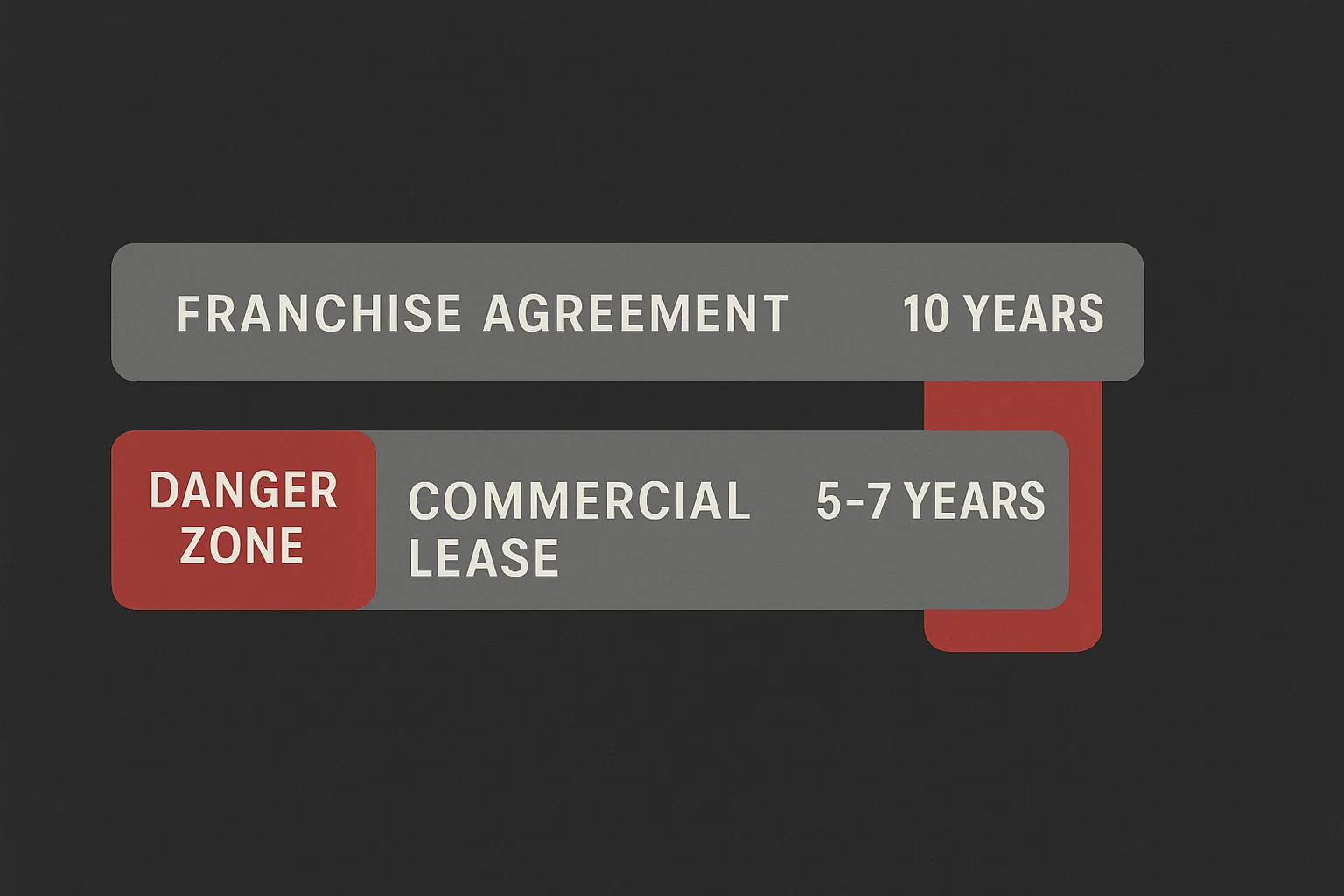
The franchise agreement is a 10-year commitment. A standard commercial lease for a 1,500–2,500 square foot strip-center space — Hotworx’s typical format — runs 5 to 7 years with renewal options. These two clocks start ticking on the same day but expire at different times. That mismatch creates leverage problems, exit complications, and financial exposure that first-time franchisees rarely anticipate until one contract expires and the other doesn’t.
This is the kind of strategic advice a franchise attorney charges $5,000–$10,000 to provide. Here’s what they’d tell you.
Two Contracts, One Business, Zero Coordination
The structural problem is simple:
| Contract | Counterparty | Typical Term | Renewal | Your Leverage |
|---|---|---|---|---|
| Franchise Agreement | Hotworx (franchisor) | 10 years | $19,950 renewal fee + compliance | Low — franchisor sets terms |
| Commercial Lease | Landlord | 5–7 years (base) | Negotiated options | Depends on timing |
These documents are negotiated with different counterparties at different times and governed by different legal frameworks. The franchise agreement is a federal/state regulated instrument that follows FTC disclosure rules. The lease is a private commercial contract governed by state real estate law. Your franchise attorney and your real estate attorney may never speak to each other — and that gap is where the timing trap lives.
As franchise lease specialists note, the lease and franchise agreement must not conflict — but ensuring alignment requires intentional coordination that most first-time franchisees don’t think to demand.
Scenario A: Your Lease Expires at Year 5, and Your Landlord Knows You Can’t Move
You signed a 5-year lease with a 5-year renewal option. At year 5, the lease comes up for renewal. You’re halfway through your franchise agreement. Your studio has been operating for five years, your membership base is established, and you’ve invested $150,000–$400,000 in build-out: specialized HVAC for infrared equipment, electrical upgrades for sauna power draw, branded interior finishes, and ADA-compliant modifications.
The landlord knows all of this. And the landlord knows something else: you can’t relocate.
Moving a Hotworx studio means:
- Abandoning your build-out investment (leasehold improvements rarely transfer)
- Notifying the franchisor and getting approval for a new location
- Paying for an entirely new build-out at the new site
- Losing members during the transition — some permanently
- Disrupting your business for 3–6 months during construction
The rational economic decision is to stay. The landlord knows this. Your renewal negotiation leverage is effectively zero.
The financial impact: In a typical mid-size market, a landlord exploiting this leverage can push rent escalation 10–20% above what market conditions would justify. On a 2,000 square foot studio at $20/sqft, a 15% above-market escalation equals $6,000 per year in unnecessary cost. Over the remaining five years of your franchise term, that’s $30,000 — money coming directly out of the already-thin owner earnings that average $49,000–$59,000 annually.
That $30,000 isn’t a catastrophic loss. But on a business where margins are measured in thousands of dollars per month, it’s the difference between a viable investment and one that underperforms every projection you showed your SBA lender.
Scenario B: Your Franchise Expires at Year 10, But You’re Locked Into Rent Until Year 12
Here’s the reverse problem. You signed a 7-year base lease at year 0 and exercised a 5-year renewal option at year 7. Your lease now runs through year 12. Your franchise agreement expires at year 10.
At the year-10 renewal decision, you face:
- A $19,950 franchise renewal fee
- Potential system upgrade requirements (new equipment, technology, or branding standards)
- A franchisor evaluation of your compliance history and studio performance
If you renew the franchise, you’re committing to another term — but you’ve already locked into a lease that runs beyond it. If the franchise underperforms and you decide NOT to renew at year 10, you still owe two years of rent on a space purpose-built for Hotworx infrared saunas.
The repurposing problem: A 2,000 square foot space with industrial electrical upgrades, specialized HVAC, and infrared sauna infrastructure isn’t easily repurposed. You can’t sublease it as a retail shop or an office. Finding a fitness or wellness tenant willing to take over the space with your lease terms is possible but not guaranteed — and the landlord may not approve a sublease or assignment.
The financial exposure: Two years of rent at $3,500/month (a reasonable mid-market estimate) equals $84,000 in obligation on a business you’re no longer operating. Add in the NNN charges — property taxes, insurance, and common area maintenance — and the total exposure can reach $100,000+.
Scenario C: You Want to Sell at Year 7, and the Buyer’s Math Doesn’t Work
The exit strategy analysis covers transfer mechanics and fees. But here’s the complication nobody discusses: the interaction between remaining franchise term and remaining lease term at the time of sale.
You want to sell at year 7. The buyer is getting:
- 3 years remaining on the franchise agreement
- A lease that may expire before, at the same time as, or after the franchise agreement — depending on how you structured the renewal
Each scenario creates a different problem for the buyer:
Short remaining franchise term reduces the buyer’s willingness to pay. Franchise resale multiples typically range from 2.0x to 3.5x SDE, but a 3-year remaining term pushes toward the low end of that range — or below it. The buyer faces a renewal fee and the uncertainty of franchisor approval within three years of taking over.
Uncertain lease renewal adds a second risk premium. If the lease expires at year 8 (one year after the buyer takes over), the buyer inherits the same zero-leverage renewal negotiation described in Scenario A — except they didn’t negotiate the original lease and may face even worse terms.
The transfer fee ($19,950 to a new franchisee, $10,000 to an existing Hotworx franchisee) is the smallest cost in this equation. The contract timing mismatch is the bigger deal-killer — it reduces your pool of qualified buyers and depresses your sale price.
How to Structure Both Contracts at Signing to Avoid the Squeeze
The time to solve the double-clock problem is before you sign either document. Five rules:

1. Align Your Lease Term to Your Franchise Term
Negotiate a 10-year lease — or a 5-year base with a 5-year renewal option that is exercisable at YOUR sole discretion, not subject to landlord approval or mutual agreement. The key language: “Tenant may renew for one additional five-year term by providing written notice no less than 180 days prior to expiration.”
Experienced franchise attorneys recommend lease terms that match the franchise agreement duration. If the landlord won’t offer a 10-year term, the unilateral renewal option is your insurance policy.
2. Cap Your Rent Escalation Clauses
Fixed-percentage escalation (2–3% per year) is predictable and modelable. “Market rate adjustment” at renewal gives the landlord a mechanism to reset your rent to whatever the market (or their interpretation of the market) supports. On a hidden-cost basis, uncapped escalation is one of the largest risks to long-term profitability.
Push for fixed escalation in the base term AND in the renewal option. If the landlord insists on market-rate adjustment at renewal, negotiate a cap (e.g., “market rate, not to exceed 110% of the then-current rent”).
3. Secure Assignment Rights That Match Franchise Transfer Rights
Your franchise agreement allows you to transfer the franchise to a qualified buyer subject to franchisor approval and transfer fees. Your lease needs a parallel assignment clause: the right to assign the lease to a buyer who assumes the franchise, without requiring separate landlord consent beyond credit review.
If the landlord retains the right to approve or deny lease assignment independently of the franchise transfer, you’ve given a third party veto power over your exit. This is one of the three lease mistakes that kill studios.
4. Include an Early Termination Clause Tied to Franchise Termination
If the franchise agreement terminates for any reason — non-renewal, default, or mutual agreement — you need the right to terminate the lease concurrently, subject to a reasonable penalty (typically 3–6 months’ rent). Without this clause, franchise termination leaves you with a lease obligation on a space you can no longer operate.
5. Get Both Attorneys in the Same Room
This is the cheapest insurance in franchise investing. One meeting — or even one shared review memo — between your franchise attorney and your real estate attorney costs an extra hour of legal time. That hour ensures the two contracts don’t contain conflicting terms around assignment, default triggers, renewal timing, or territorial restrictions.
A franchise attorney reviewing the FDD alone will catch franchise-specific issues. A real estate attorney reviewing the lease alone will catch lease-specific issues. Neither will catch the interaction between the two — unless you force the conversation.
The Questions to Ask Before You Sign Either Document
Use this checklist with your attorneys:
- Does my lease term match or exceed my franchise term? If not, do I have a unilateral renewal option that covers the gap?
- Are my lease renewal options exercisable at my sole discretion? Or can the landlord refuse renewal?
- Is rent escalation fixed or market-adjusted? If market-adjusted, is there a cap?
- Can I assign the lease concurrent with a franchise transfer? Does the landlord have independent approval rights that could block a sale?
- Does the franchise agreement require landlord consent for transfer? Some franchise agreements require the franchisee to obtain landlord consent as a condition of franchisor approval.
- What happens to the lease if the franchise terminates? Is there an early termination clause?
- Does the franchisor have relocation rights or requirements? Some franchise agreements allow the franchisor to require you to relocate — check whether your lease accommodates this.
- Have both attorneys reviewed both documents? Not separately — together, with specific attention to term alignment, assignment mechanics, and default triggers.
This Is a Solvable Problem — But Only Before Day One
The double-clock problem isn’t a reason to avoid franchise investing. Every franchise — not just Hotworx — operates under the same dual-contract structure. The issue is that most first-time franchisees treat the franchise agreement and the commercial lease as separate transactions when they are, functionally, two halves of the same business commitment.
The site selection playbook covers where to put your studio. The lease escalation analysis covers what your rent costs over time. This piece covers the strategic interaction between the two contracts that govern your business — and it’s the piece that could save you $30,000 to $100,000 over your franchise term.
Solve it before you sign. After that, the clocks are already running.