Pre-Sale Execution: The Variable That Determines Whether Your Hotworx Studio Opens Profitable or Underwater
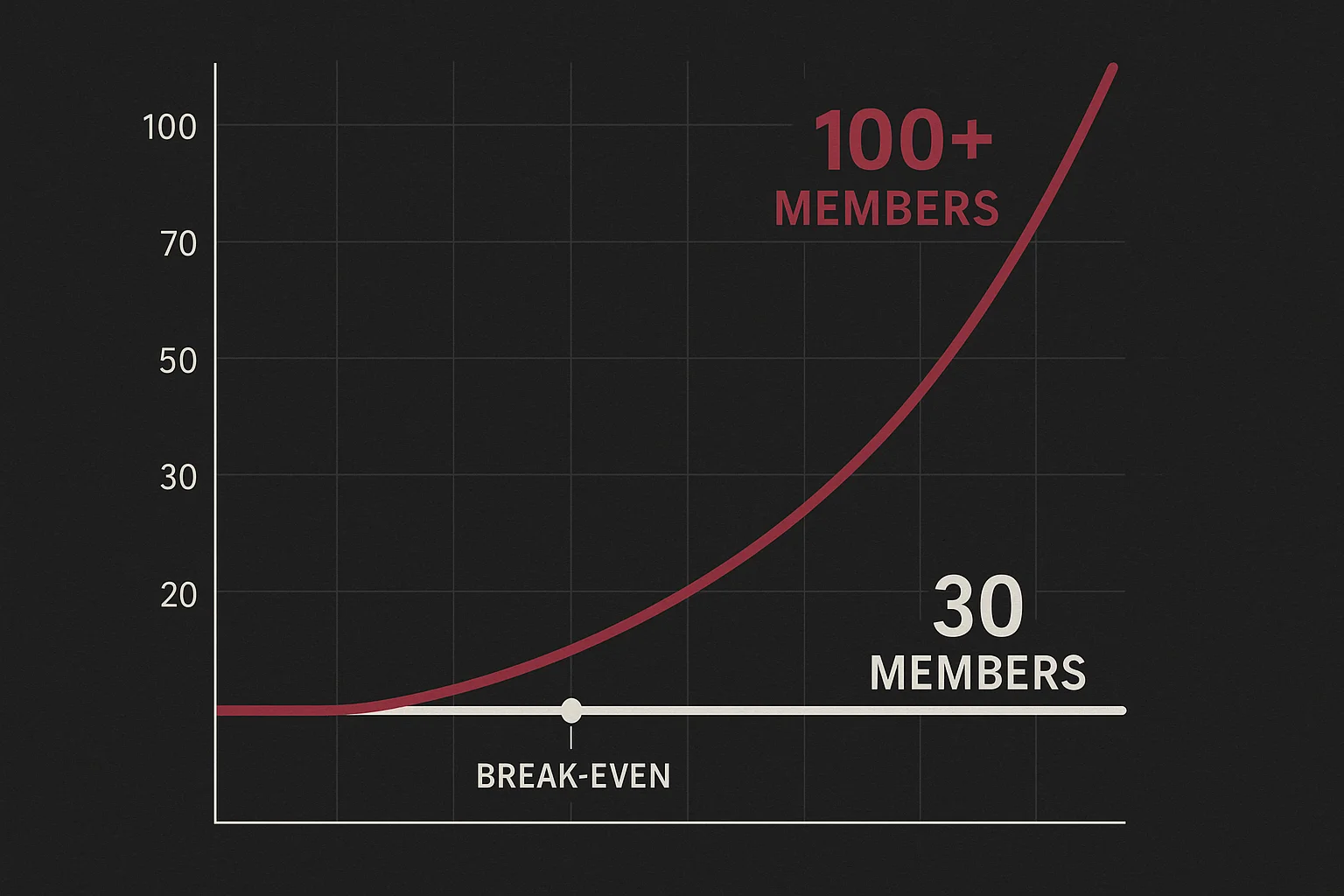
100+ founding members = break-even by month 8. No pre-sale = still bleeding cash at month 14.
Introduction
You’ve signed the franchise agreement. Your build-out is underway. And right now, in the 60–90 days before your doors open, you’re making the single decision that will determine whether your Hotworx studio reaches break-even in seven months or seventeen.
That decision is not your location. It’s not your financing structure. It’s not whether you go semi-absentee or owner-operator.
It’s pre-sale execution.
The franchise owners who treat pre-sale as a box to check — something that happens passively while the contractor finishes the sauna installations — are the same owners posting in forums at month 14 asking how long it “usually” takes to stop losing money. The owners who run pre-sale like a disciplined, fully-staffed campaign open with 100+ members and a revenue base that covers fixed costs from nearly day one.
Here’s exactly what the difference looks like, in dollars and timelines.
Why Pre-Sale Is the Highest-Leverage Decision You’ll Make
The basic math is straightforward. A Hotworx studio needs approximately 250–312 active members to break even, assuming an average effective membership rate of $59/month and monthly fixed costs in the $15,000–$18,000 range (rent, royalties, staffing, utilities, insurance — the full picture is in our hidden operating costs breakdown).
What varies dramatically is how long it takes to get there.
- Studios that opened with 80–120 founding members hit break-even in 6–8 months.
- Studios that opened with fewer than 40 members took 14–18 months.
- The financial difference between those two scenarios: $30,000–$60,000 in additional working capital burned during the gap.
That’s not a rounding error. That’s the difference between your SBA loan’s working capital reserve lasting comfortably through stabilization and you pulling from personal savings at month 11 to make payroll.
Pre-sale is not a “nice to have.” It’s not a marketing initiative. It is the variable that determines whether your cash reserves survive year one. Every owner account that tracks first-year financial performance points back to the same conclusion: opening membership count is the strongest single predictor of time-to-profitability.
The Pre-Sale Timeline: 60–90 Days That Define Your First Two Years
Pre-sale typically launches 60–90 days before grand opening. The trigger is your lease signing — once the build-out clock starts, the pre-sale clock starts with it.
This is not optional sequencing. You need the full window. Studios that compressed pre-sale into 30 days consistently underperformed studios that ran the full 90, regardless of marketing spend.
The three phases break down like this:
Phase 1: Awareness (Weeks 1–3)
- Social media launch: dedicated studio page, local community group engagement
- Signage at the build-out location (your single best-performing awareness asset if you have street visibility)
- Local partnership outreach: yoga studios, supplement shops, wellness practitioners, corporate wellness programs
- Community event presence: farmers markets, charity 5Ks, local business networking
The goal here is not sign-ups. It’s name recognition. You’re seeding the market so that when your conversion push starts in Phase 2, people have already heard of you.
Phase 2: Conversion (Weeks 4–8)
- Founding member pricing goes live with clear urgency mechanics (limited spots, deadline, price increase at opening)
- Personal outreach: direct messages, phone calls, one-on-one conversations at community events
- Referral incentives for early sign-ups (free month for every friend who joins)
- Paid advertising ramps up with conversion-optimized creative
This is the phase where your numbers either materialize or don’t. If you don’t have 20+ members by the end of week 4, something is wrong with your strategy, your pricing, or your market.
Phase 3: Lock-In (Weeks 9–12)
- Payment processing setup for all founding members
- Onboarding communications: what to expect, opening day details, first-session scheduling
- Final push for referral sign-ups from existing founding members
- Transition planning from pre-sale mode to ongoing operations
Here’s what makes pre-sale fundamentally different from ongoing member acquisition: you’re selling access to something that doesn’t exist yet. There’s no studio to tour, no sauna to demo, no class to try. This requires a different sales approach than walk-in conversions — it’s closer to selling a vision and a deal than selling an experience. If you’re not comfortable with that kind of outbound, relationship-driven selling, you need someone on your team who is. The first 90 days timeline covers how this fits into the broader opening sequence.
Founding Member Economics: What You’re Actually Offering
The founding member offer is a straightforward value exchange: early commitment in exchange for a permanently discounted rate.

Here’s how the numbers typically work:
- Founding member rate: $39–$49/month (vs. standard $59–$79/month)
- Enrollment fee: Waived or reduced to $0–$49 (vs. standard $99–$149)
- Lock-in terms: Founding member rate is permanent as long as the member maintains continuous membership
The discount math is worth understanding precisely. If you offer 100 founding members a rate that’s $20/month below standard, that’s $2,000/month in revenue you will never recapture from those members. But without pre-sale, you wouldn’t have had those members at all — so the real comparison is $4,500/month in founding member revenue versus $0 in day-one revenue.
That $4,500/month on opening day is what lets you cover a significant portion of fixed costs immediately, rather than burning through reserves while you acquire members one by one at full price.
The long-term P&L implication is real, though. Those 100 founding members at $45/month generate $54,000/year. At full price ($65/month average), they’d generate $78,000. That’s a $24,000 annual revenue gap that persists for as long as those members stay. This is the trade-off — and it’s worth making, because the alternative (no pre-sale revenue) costs you far more in working capital burn than the discount ever will.
One more data point that tips the scale: founding members show 15–20% higher 12-month retention than members who join post-opening. They’re self-selected early adopters who are psychologically invested in the brand before it even opens. That retention premium partially offsets the rate discount over time.
The Pre-Sale Marketing Stack: What It Costs and What Works
Pre-sale marketing is a separate budget from the FDD’s “Initial Marketing” line item. Plan for $5,000–$15,000 dedicated to pre-sale, depending on your market competitiveness and your willingness to do personal outreach versus paying for reach.
Here’s the channel-by-channel breakdown:
Paid social (Facebook/Instagram ads): $2,000–$5,000
Hyper-local targeting within a 5-mile radius of your studio location. Lead generation campaigns with founding member pricing as the hook. This builds awareness efficiently but converts at lower rates than personal outreach during pre-sale specifically.
Google Local Services / Search ads: $1,000–$3,000
Captures people actively searching “fitness near me,” “infrared sauna [city],” or “Hotworx [city].” Lower volume than social but higher intent. Worth running from week 1 for the member acquisition cost data alone — you’ll want those benchmarks for post-opening marketing.
Community partnerships: $0–$2,000
Referral arrangements with complementary local businesses — yoga studios, supplement shops, chiropractors, wellness-focused employers. Cost is minimal (co-marketing materials, referral incentives). Conversion rate is the highest of any channel during pre-sale.
Grand opening events: $1,000–$3,000
Soft launch parties, local influencer invites, press outreach. These serve double duty: converting fence-sitters and generating social proof content for ongoing marketing.
Signage and window wraps: $500–$2,000
If your location has street visibility, this is your best ROI asset. A “Coming Soon — Founding Members Save 40%” window wrap works 24/7 and costs nothing after the initial install.
The data from owner accounts is consistent: personal outreach and community events outperform paid digital ads roughly 3:1 during pre-sale. But the paid ads build the awareness foundation that makes personal outreach effective. You need both.
The Staffing Question
Who actually runs pre-sale? You have three options:
- You do it yourself. Highest conversion rates (nobody sells your business like you do), but it means you’re not managing the build-out, not finalizing operations, not doing the dozen other things that need to happen before opening.
- Your studio manager. If you’ve hired early enough, this gets your manager invested in the business from day one and builds their sales skills. Requires someone comfortable with outbound selling.
- A contracted pre-sale specialist. Some markets have fitness pre-sale consultants who do this for a flat fee ($3,000–$8,000) or per-member commission. Expensive, but they bring systems and experience.
The right answer depends on your operating model — but the wrong answer is “nobody” or “we’ll get to it after build-out.”
Pre-Sale Benchmarks: What the Numbers Should Look Like
Track your pre-sale weekly against these benchmarks. If you’re falling behind the conservative scenario, you need to either change your strategy, increase your budget, or adjust your financial projections.
| Week | Conservative | Base Case | Aggressive |
|---|---|---|---|
| 2 | 5–8 members | 8–12 members | 12–18 members |
| 4 | 15–20 members | 20–30 members | 30–40 members |
| 6 | 30–40 members | 40–55 members | 55–70 members |
| 8 | 45–55 members | 60–80 members | 80–100 members |
| 10 | 60–70 members | 80–95 members | 100–120 members |
| 12 | 75–90 members | 100–120 members | 125–150+ members |
Key checkpoints:
- Week 4 with fewer than 15 members: Reassess your strategy immediately. Either your pricing isn’t compelling, your marketing isn’t reaching the right audience, or your market has a demand problem.
- Week 8 with fewer than 40 members: This is a red flag. You need to either extend the pre-sale period (delay opening if build-out allows it), significantly increase marketing spend, or prepare larger working capital reserves. Do not ignore this signal.
- Week 12 with 100+ members: You’re in strong position. Break-even within 8 months is realistic with continued member acquisition post-opening.
Here’s the part most franchise consultants won’t tell you: if your pre-sale response is weak despite genuinely strong execution — good pricing, adequate budget, consistent personal outreach — that’s not just a marketing failure. That’s data about your location and territory. Weak pre-sale in a well-executed campaign suggests the market may not support the membership volume you need, or your specific site lacks the visibility and accessibility to generate organic interest. That’s worth understanding before you open, not after.
The Financial Model: Pre-Sale vs. No Pre-Sale
This is where the impact becomes impossible to ignore. Two scenarios, same studio, same market, same cost structure — different pre-sale outcomes.
Scenario A: Strong Pre-Sale (110 Founding Members)
- Day-one revenue: 110 members × $45/month = $4,950/month
- Monthly fixed costs: ~$15,500 (rent, royalties, staffing, utilities, insurance)
- Monthly gap at opening: −$10,550
- Post-opening member acquisition: ~15–20 new members/month at $65 average
- Break-even point: Month 7 (~260 total members)
- Total cash burn to break-even: ~$45,000–$55,000
Scenario B: Weak/No Pre-Sale (30 Members)
- Day-one revenue: 30 members × $59/month = $1,770/month
- Monthly fixed costs: ~$15,500
- Monthly gap at opening: −$13,730
- Post-opening member acquisition: ~15–20 new members/month at $65 average
- Break-even point: Month 16 (~260 total members)
- Total cash burn to break-even: ~$115,000–$135,000
The gap: 9 additional months of negative cash flow, totaling $70,000–$80,000 in extra capital required.
That difference reshapes your entire financing picture. SBA lenders model working capital reserves based on projected time-to-break-even. A strong pre-sale narrative — with signed founding members as evidence — makes your loan application materially stronger. It demonstrates market demand, execution capability, and a shorter runway to profitability. Some lenders will approve lower working capital reserves (and thus a smaller total loan) when pre-sale numbers are strong, which reduces your total debt service burden.
For a detailed look at how the full SBA financing structure interacts with your pre-opening capital plan, see our financing analysis.
The Mistakes That Kill Pre-Sale
These are not theoretical risks. They are the specific failures that show up repeatedly in owner accounts from studios that opened underwater.
1. Starting too late.
Pre-sale needs the full 60–90 days. Compressing it to 30–45 days because the build-out ran long or you “didn’t get around to it” cuts your results by 40–60%. If your build-out timeline shifts, your pre-sale timeline should shift with it — delay opening if you have to, but don’t shortchange the pre-sale window.
2. Pricing too high.
A founding member rate of $5 off standard pricing is not a compelling offer. It doesn’t create urgency and it doesn’t feel like a genuine reward for early commitment. The discount needs to be meaningful — $15–$25/month below standard — or people will simply wait until the studio opens and they can see it in person.
3. No dedicated staff.
You cannot manage a build-out, finalize operations, complete training, and run a pre-sale campaign simultaneously. Something will get dropped, and it’s almost always pre-sale. Assign a dedicated person — you, your manager, or a contractor — whose primary job for 60–90 days is signing founding members.
4. Digital-only approach.
Running Facebook ads from your couch while the studio gets built is not pre-sale execution. Digital creates awareness. Conversion during pre-sale comes from personal outreach, community events, local partnerships, and face-to-face conversations. Studios that relied exclusively on paid digital for pre-sale consistently signed 40–60% fewer founding members than studios that combined digital with community presence.
5. Not tracking weekly.
If you’re not measuring weekly sign-ups against the benchmarks above, you’re flying blind. Pre-sale is a finite window with no do-overs. By the time you realize at week 10 that you only have 25 members, there’s not enough runway to recover. Weekly tracking gives you time to adjust strategy, increase spend, or extend the timeline.
6. Over-discounting without retention terms.
Offering a permanent founding member rate with no minimum commitment creates a scenario where members sign up for the deal, attend twice, and cancel — locking in a discounted rate they never meaningfully use while occupying a founding member slot that could have gone to someone who’d actually show up. Include reasonable commitment terms: a 3–6 month minimum or a cancellation fee that recoups the enrollment fee waiver.
What This Means for Your Decision
Pre-sale execution is not a marketing tactic. It is a financial strategy that determines the trajectory of your first two years as a Hotworx franchise owner.
If you are currently evaluating a Hotworx investment, the questions to ask yourself are specific:
- Do I have 60–90 days between lease signing and opening to run a full pre-sale?
- Do I have $5,000–$15,000 in pre-sale marketing budget beyond the FDD’s initial marketing line?
- Do I have a person — myself, a manager, or a contractor — who can dedicate themselves to pre-sale full-time?
- Is my location in a market where I can realistically sign 80–120 founding members in 12 weeks?
If the answer to any of those is no, you need to either change your plan or adjust your financial projections to account for a longer path to break-even — and the additional working capital that requires.
The studios that open strong don’t get lucky. They execute a disciplined, fully-resourced pre-sale campaign that gives them a revenue base on day one. Everything after that — ongoing marketing, retention, upselling, operational efficiency — matters. But none of it matters as much as whether you had 30 members or 110 members when you turned on the lights.
This analysis is based on publicly available franchise disclosure documents, owner-reported financial data, and industry benchmarks. Hotworx Franchise Intel is an independent research publication with no financial relationship with Hotworx or its franchisor. See our editorial independence statement for methodology and sourcing standards.