Hotworx vs. Planet Fitness: The $350K vs. $1.6M Franchise Investment Thesis
This isn’t a workout comparison. It’s a capital allocation decision — and the right answer depends on what kind of operator you want to be.
Introduction
If you have $350,000 to $1.5 million in accessible capital and you’re evaluating fitness franchises, two names sit at opposite ends of the spectrum: Hotworx, the infrared boutique studio with 800+ locations and a semi-absentee pitch, and Planet Fitness, the 2,500+ location value gym that trades on the NYSE under PLNT. Every other comparison on this site — Hotworx vs. Orangetheory vs. F45 — stays within the boutique category. This one crosses categories entirely, because that’s how real investment decisions work.
A franchise investor choosing between Hotworx and Planet Fitness isn’t comparing infrared saunas to treadmills. They’re comparing two fundamentally different business models, two different capital requirements, two different operator lifestyles, and two different bets on where the fitness market is headed.
The Numbers Side-by-Side
Before analyzing strategy, look at the financial structures. These numbers come from the most recent Franchise Disclosure Documents and industry research.
| Metric | Hotworx | Planet Fitness |
|---|---|---|
| Total Investment | $356,299–$1,182,389 | $1,525,000–$5,221,500 |
| Franchise Fee | $19,950 | $0–$20,000 |
| Average Gross Revenue | ~$330,000 | ~$1,870,000 (median) |
| Top-Third Revenue | Not disclosed | $2,400,000+ |
| Estimated Owner Earnings | $49,000–$59,000 | $215,000–$269,000 |
| Royalty Structure | Flat $700–$900/month | 7% of gross revenue |
| Estimated Payback | 14.6–16.6 years | 7–9 years |
| Studio/Club Size | 1,500–2,500 sqft | 15,000–20,000 sqft |
| Member Capacity | ~250 members | 6,000+ members |
| Staff Required | 3–5 employees | 15–30 employees |
| Locations (2026) | 800+ | 2,500+ |
| Publicly Traded | No | Yes (NYSE: PLNT) |
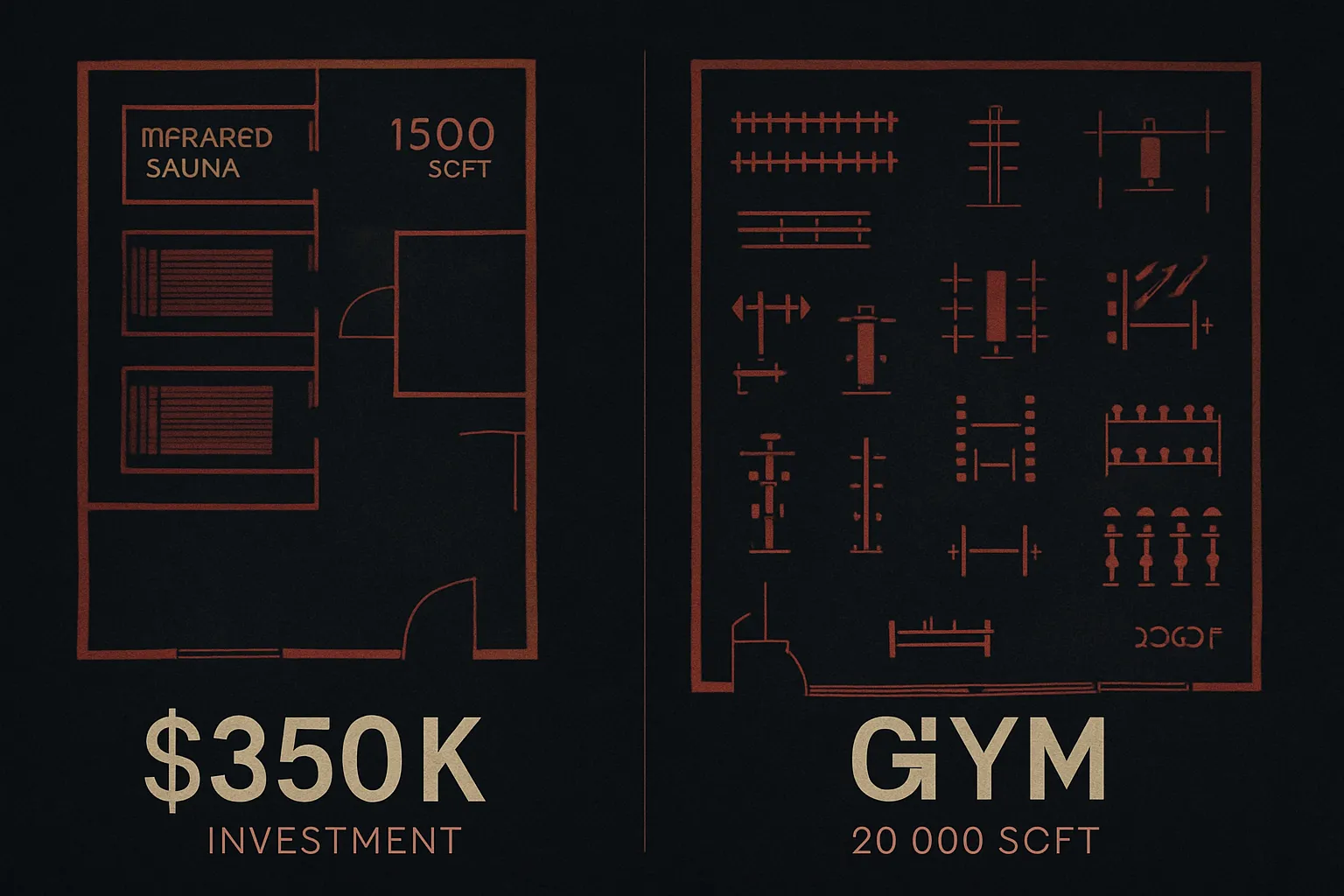
The absolute numbers favor Planet Fitness on revenue and earnings. But absolute numbers are misleading without context. A Planet Fitness club generating $1.87M in revenue on a $3M investment is a different proposition than a Hotworx studio generating $330K on a $500K investment. The question is return on deployed capital — and risk per dollar.
The Operator Question: What Kind of Business Do You Want to Run?
The financial comparison only makes sense alongside the operational reality. These two franchises demand fundamentally different things from their owners.
Hotworx: The Compact Operator
A Hotworx studio is a small-footprint, technology-driven business. At 1,500–2,500 square feet with 3–5 employees and unmanned overnight hours, it’s designed to minimize operational complexity. The virtual instructor model eliminates instructor hiring, scheduling, and turnover. The semi-absentee ownership thesis — which Hotworx actively markets — suggests an owner can manage the business in 15–20 hours per week once the studio reaches steady state.
The reality is more nuanced (the site’s semi-absentee analysis digs into this), but the structural truth holds: running a Hotworx studio requires managing a very small team, a very small space, and a very specific member base.
Hotworx’s flat royalty ($700–$900/month) is a structural advantage. Whether your studio generates $200K or $500K in revenue, your royalty payment stays the same. As revenue grows, the royalty becomes a smaller percentage of gross — effectively rewarding growth. Compare this to Planet Fitness’s 7% royalty: on $1.87M in revenue, that’s $131,000 per year paid to the franchisor.
Planet Fitness: The Scale Operator
A Planet Fitness club is a full-scale business. A 15,000–20,000 square foot facility with 15–30 employees, thousands of members, and the complexity that comes with high-volume operations: HR management, equipment maintenance cycles on hundreds of machines, facility upkeep for a space the size of a small grocery store, and a brand identity that requires careful local marketing execution.
This is not semi-absentee. Planet Fitness franchisees who succeed are typically experienced multi-unit operators or partnerships with dedicated management teams. The minimum net worth requirement is $3 million with $1.5 million in liquid assets — Planet Fitness is selecting for operators with business management experience, not first-time franchisees looking for a side project.
Planet Fitness’s 7% royalty scales with your success — and your pain. On a strong-performing club ($2.4M+ revenue), you’re paying $168,000+ in annual royalties. That’s more than many Hotworx studios generate in total revenue. But 7% on $2.4M still leaves you with far more absolute profit than a flat $900/month on $330K.
Risk Profile: What Can Go Wrong
Every franchise investment carries risk. The question is what KIND of risk you’re taking on.
Hotworx-Specific Risks
- Revenue ceiling. A 250-member-capacity studio in 2,000 square feet has a structural revenue ceiling. At $59/month per member, a fully utilized studio generates roughly $177,000 in membership revenue — unit economics analysis shows how ancillary revenue and pricing tiers push actual averages to $330K, but the ceiling is still low compared to high-volume models.
- Category risk. Infrared fitness is a trend-dependent category. If consumer interest in infrared cools or shifts to multi-modality wellness, your single-modality studio can’t pivot without franchisor approval and additional investment.
- Regulatory overhang. Hotworx’s marketing references health benefits of infrared that, if challenged by the FDA, could require messaging changes that reduce consumer demand.
- Territory saturation. At 800+ studios targeting 1,000 by year-end 2026, the best territories are being claimed. Late entrants may face less favorable locations.
Planet Fitness-Specific Risks
- Capital exposure. A $3M+ investment means a proportionally larger loss if the club underperforms. The complete downside model applies in principle: when a high-investment franchise fails, the personal financial damage is severe.
- Real estate commitment. Leasing 15,000–20,000 square feet locks you into a massive monthly obligation. If membership drops, you can’t shrink your footprint.
- Anti-gym positioning. Planet Fitness’s “Judgment Free Zone” branding deliberately targets non-gym-goers. This is a genius market-creation strategy but also means competing against the trend toward specialized, intense, results-driven fitness — exactly the market Hotworx targets.
- Margin pressure from price positioning. At $15/month for the base membership, Planet Fitness has almost no pricing power. Revenue growth comes from volume, not price increases.
The Recession Variable
This is where the models diverge most sharply.
Planet Fitness historically gains members during economic downturns. When consumers cut spending, they downgrade from $150/month boutique memberships to $15/month Planet Fitness memberships. Planet Fitness’s 2008–2010 growth was built on this dynamic.
Hotworx sits on the wrong side of that trade. At $59/month, it’s a discretionary wellness expense that consumers cut when budgets tighten. The site’s recession analysis models this in detail — but the summary is that Hotworx is a growth-economy play, while Planet Fitness is an all-weather play.
The Financing Reality
Both franchises are on the SBA Franchise Directory, making them eligible for SBA 7(a) financing. But the underwriting process looks different at each investment level.
Planet Fitness’s advantage: transparency. As a publicly traded company, Planet Fitness’s system-wide financials are available in SEC filings. Lenders have audited, verifiable data on unit performance, failure rates, and system health. This reduces perceived risk and can lead to more favorable loan terms.
Hotworx’s advantage: lower personal exposure. An SBA 7(a) loan for a $500K Hotworx investment means a smaller personal guarantee than a $2M+ Planet Fitness loan. If the business fails, the personal financial impact — while still significant — is proportionally smaller.
The multi-unit math is where it gets interesting. Three Hotworx studios at $400K each ($1.2M total) vs. one Planet Fitness club at $2M. The Hotworx portfolio gives you diversification across three locations, three lease negotiations, and three member bases. If one studio underperforms, the other two may carry it. The Planet Fitness club is a single concentrated bet — higher upside, higher concentrated risk.
For franchise investors navigating these financing decisions, Lendesca provides resources for understanding SBA loan structures and how lenders evaluate different franchise investment levels — whether you’re underwriting a single boutique studio or a large-format gym.
Which One Is Right for You: A Decision Framework
There is no universally “better” franchise investment between these two. The right answer depends on your specific situation.
The Hotworx thesis works if:
- You have $300K–$600K in accessible capital (savings + SBA financing)
- You want the option for semi-absentee involvement after the first year
- You believe wellness and infrared fitness represent a secular growth trend, not a cycle
- You prefer lower absolute risk per location and are willing to accept lower absolute returns
- You’re considering multi-unit ownership to build a portfolio over time
The Planet Fitness thesis works if:
- You have $1.5M+ in liquid assets and can access $3M+ in total capital
- You have multi-unit franchise or business management experience
- You want proven, stable unit economics with a publicly disclosed track record
- You prioritize recession resilience and all-weather demand
- You’re comfortable managing a 20+ person team and a large physical facility
The hybrid approach: Some investors deploy capital across both models — one Planet Fitness club as the anchor investment and two to three Hotworx studios as satellite investments in adjacent territories. This creates diversification across business models, price points, and customer demographics. It’s capital-intensive but strategically sound if you have the management bandwidth.
The worst decision is choosing based on which workout you personally prefer. The best decision is choosing based on an honest assessment of your capital position, risk tolerance, management capacity, and investment timeline. The FDD Item 19 analysis for Hotworx and the Planet Fitness SEC filings give you the raw data. This comparison gives you the framework to interpret it.
This analysis uses publicly available FDD data, SEC filings, industry reports, and disclosed financial information. It does not constitute investment advice. Consult a franchise attorney and financial advisor before signing any franchise agreement.