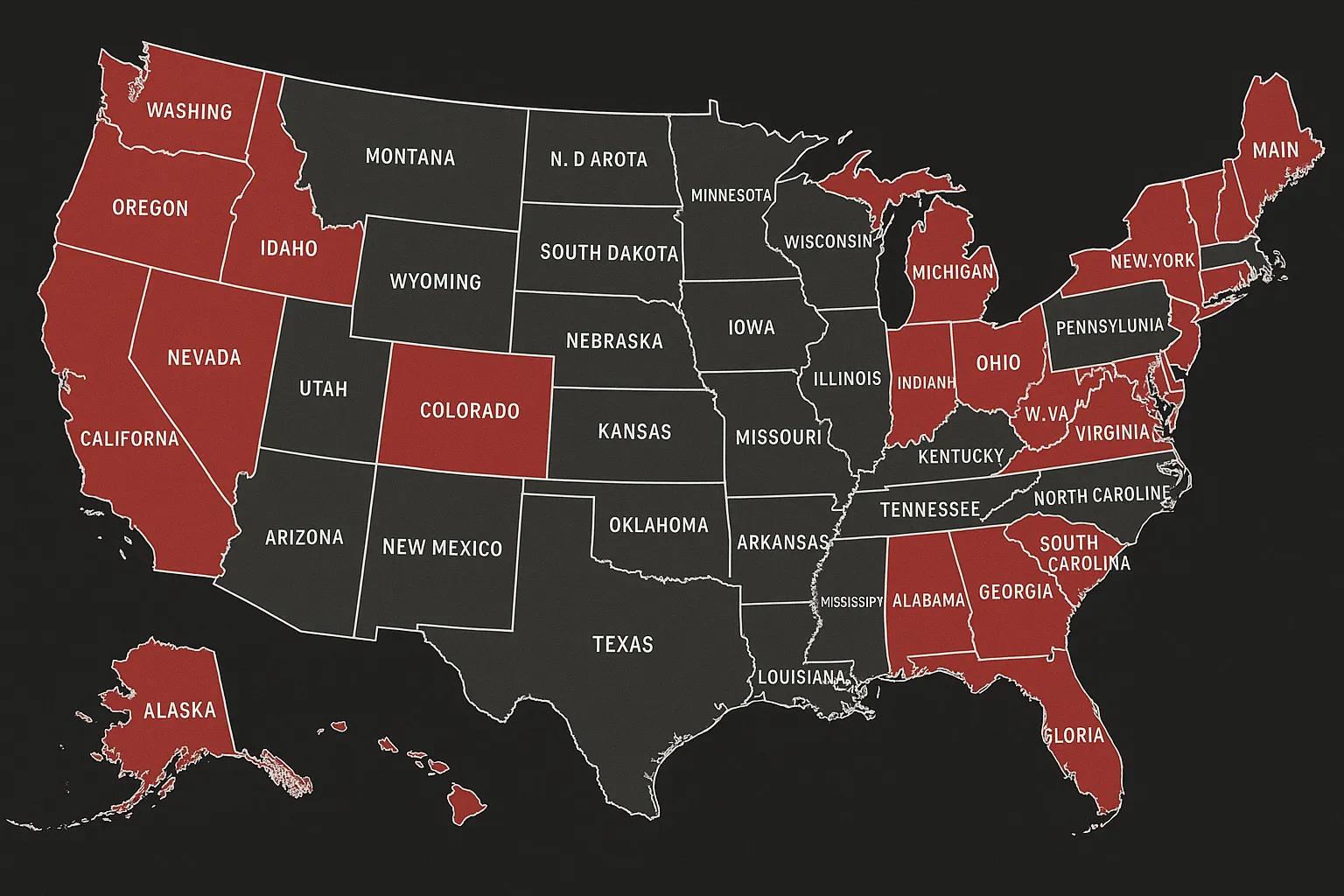
State Gym Contract Laws: Why Your Hotworx Membership Revenue Model May Not Be Legal Everywhere
At least 30 states regulate health club contracts. Hotworx’s 6-month lockup, $99 cancellation fee, and auto-renewal may not survive contact with every state’s consumer protection code.
Introduction
You’re building a revenue model for a Hotworx franchise. You’ve got the membership price, the 6-month initial commitment, the 60-day cancellation notice period, and the $99 early termination fee baked into your spreadsheet. The math works. The problem is that the math assumes those terms are enforceable in your state.
They may not be.
At least 30 states have specific consumer protection statutes that regulate health club and gym membership contracts. These aren’t general business codes — they’re targeted legislation that dictates what fitness businesses can and can’t require of their members. And they override whatever your franchisor’s standard membership agreement says.
If you’re modeling Hotworx revenue based on national-average contract enforcement, you’re modeling fiction. The real number depends on where you open.
The Revenue Model Assumption Nobody Questions
Hotworx’s standard membership agreement creates a layered retention structure. Here are the terms that matter to your P&L:
- 6-billing-cycle initial lockup: Members commit to a minimum of 6 months before cancellation is available
- 60-day cancellation notice: After the initial term, members must provide 60 days’ written notice to cancel
- $99 early termination fee: Members who exit before the 6-month commitment pay a penalty
- $9/month freeze fee: Disengaged members who don’t want to cancel outright pay to pause
- Auto-renewal: After the initial term, membership renews month-to-month at the standard rate until actively canceled
These terms produce predictable revenue. At $59/month, the 6-month lockup guarantees a minimum of $354 per member. The 60-day notice period adds roughly two more billing cycles per churning member. The early termination fee discourages mid-contract exits. Together, they create a revenue floor that makes your unit economics pencil out.
The assumption embedded in every Hotworx franchise financial model is that these terms are uniformly enforceable. That assumption is wrong.
The State Regulatory Landscape: What You Need to Know
Health club contract regulation isn’t a niche legal issue. It’s one of the most active areas of state-level consumer protection law. At least 30 states have statutes specifically targeting fitness and health club memberships — separate from their general consumer protection codes.
These laws vary on several critical dimensions:
- Maximum contract length — some states cap the initial commitment period, which can limit your ability to lock members into multi-month terms
- Mandatory cooling-off periods — the right to cancel within a set number of days after signing, with a full refund. Typically 3–5 business days, but some states extend this window
- Auto-renewal restrictions — requirements for advance written notice before renewal, or limits on automatic billing continuation. Some states require 30–60 days’ notice to the member before any auto-renewal billing occurs
- Cancellation fee caps or outright prohibitions — some states ban early termination fees entirely; others cap them at a specific dollar amount or a percentage of the remaining contract value
- Required refund provisions — pro-rata refunds upon cancellation, medical event, relocation, or death. Some states mandate refunds within 15–30 days
- Bond or trust fund requirements — pre-paid membership revenue must be held in escrow or backed by a surety bond, protecting members if the studio closes
- Mandatory contract disclosures — specific language that must appear in the membership agreement, including cancellation procedures printed in bold or conspicuous type
Every one of these dimensions touches a different line item in your Hotworx revenue model. And the variation between states isn’t marginal — it’s dramatic.
The states without specific gym contract legislation tend to cluster in the Mountain West and parts of the Southeast. The states with the most aggressive regulation are concentrated in the Northeast, the West Coast, and the upper Midwest. If you’re evaluating Hotworx locations in multiple states, you may be looking at fundamentally different revenue models for each one.
Five States That Change the Hotworx Revenue Model
Not every state creates the same exposure. Here are five with regulations that directly conflict with standard Hotworx membership terms.
California (Health Studio Services Contract Law, Civil Code §1812.80–1812.98)
California’s Health Studio Services Contract Law is one of the most prescriptive in the country.
Key provisions:
- 5-day right to cancel after signing, with a full refund required
- Pro-rata refund available if the member cancels within 30 days
- Relocation cancellation rights if the member moves more than 25 miles from the studio
- Medical cancellation rights with documentation
- Contracts limited to 36 months (not a direct issue for Hotworx’s post-lockup month-to-month structure, but the cooling-off and refund provisions are)
Impact on your Hotworx model: The $99 early termination fee is likely unenforceable. The 60-day cancellation notice period conflicts with the state’s pro-rata refund requirements. Every new member gets a 5-day free exit. In a high-volume sign-up month — say you sign 30 new members during a January promotion — that 5-day window alone could cost you 3–5% of new member revenue if your sales process creates buyer’s remorse. California also requires that cancellation notices be accepted by mail, which undercuts Hotworx’s in-person cancellation requirement. A member who sends a certified letter has legally canceled whether your front desk processes it or not.
New York (General Business Law §621–625)
New York’s health club provisions add a layer that directly undermines the lockup model.
Key provisions:
- 3-day right to cancel with a full refund
- Contract cannot exceed 36 months
- Club must post a bond or maintain a trust account to protect pre-paid membership fees
- Cancellation available for disability or relocation beyond 25 miles
- Monthly payment option must always be available
Impact on your Hotworx model: The mandatory monthly payment option is the critical provision here. If a New York member can elect month-to-month from day one, your 6-month lockup doesn’t lock anyone up. The bond requirement is an additional cost — typically 10–15% of pre-paid contract value — that doesn’t appear in the standard Hotworx startup cost model.

Illinois (Health Club Services Act, 815 ILCS 645)
Illinois takes a similar approach to New York, with provisions that erode the predictable-revenue architecture.
Key provisions:
- 3-day cooling-off period with full refund
- Contract limited to 36 months
- Monthly payment option must be offered
- Pro-rata refund on cancellation
- Bond requirement for pre-paid contracts
Impact on your Hotworx model: Same monthly-payment-option problem as New York. If Illinois members can pay month-to-month without a lockup commitment, your minimum contracted revenue per member drops from $354 to $59. That’s an 83% reduction in your revenue floor per sign-up.
Florida (Health Studio Act, Chapter 501.012–501.019)
Florida is one of the largest franchise markets in the country, which makes its health studio regulations particularly relevant.
Key provisions:
- 3-day cancellation right after signing
- Contracts limited to 36 months
- Cancellation available for death, disability, or relocation beyond 25 miles
- Required refund procedures within 30 days of valid cancellation
- Health studio bond requirement — studios must maintain a surety bond
Impact on your Hotworx model: Florida’s bond requirement adds a direct cost. The relocation cancellation right creates exposure in transient markets like Miami, Orlando, and Tampa — cities where a meaningful share of your member base may move within the first year. If 8–12% of your members relocate annually (common in Florida metro areas), that’s 8–12% of your base with an immediate, penalty-free exit right.
Connecticut (Conn. Gen. Stat. §21a-215 to 21a-221)
Connecticut’s health club laws are among the most member-friendly in the Northeast.
Key provisions:
- Contracts limited to 36 months
- 3-day cancellation right with full refund
- Monthly payment option must be available
- Cancellation for disability or relocation
- Bond or letter of credit requirement
Impact on your Hotworx model: Connecticut combines the monthly-payment mandate (destroying the lockup) with the bond requirement (adding cost). In a small-market Connecticut studio with 200 members, the compound effect of no enforceable lockup plus bond carrying costs could reduce your first-year effective revenue by 10–18% versus the standard franchise model.
The Revenue Impact: Modeling the Difference
Abstract legal analysis doesn’t pay your rent. Here’s what these regulations look like in a revenue model.
Base Model: Unrestricted State
Assumptions: 250 active members, $59/month, standard 6-month lockup enforced, $99 early termination fee collected, 25% annualized churn.
| Metric | Value |
|---|---|
| Monthly recurring revenue | $14,750 |
| Minimum contracted revenue per new member | $354 |
| Early termination fees collected (est. 15 exits/yr) | $1,485/year |
| 60-day cancellation tail revenue (63 churning members) | $7,434/year |
| Effective annual revenue | $186,419 |
Restricted-State Model: Monthly Payment Mandate + No ETF
Assumptions: same 250 members, but monthly payment option available from day one, early termination fee unenforceable, 3-day cooling-off exercised by 5% of new sign-ups, churn rate 30–33% (higher due to no lockup friction).
| Metric | Value |
|---|---|
| Monthly recurring revenue | $14,750 (same base) |
| Minimum contracted revenue per new member | $59 (one month, no lockup) |
| Early termination fees collected | $0 |
| 60-day cancellation tail revenue | Reduced or $0 |
| Cooling-off period refunds (est.) | –$1,475/year |
| Higher churn cost (additional 15–20 members lost/yr at $59) | –$10,620 to –$14,160/year |
| Effective annual revenue | $161,500–$167,800 |
The gap: $18,600 to $24,900 per year. That’s 10–13% less revenue from the same member count in year one. And it compounds.
Higher churn means higher member acquisition costs to maintain the same headcount. If your cost to acquire a new member is $150–$250 (marketing, promotions, free-trial costs), replacing an additional 15–20 members per year costs $2,250–$5,000 in acquisition spending alone. That spending compresses your operating margin further, and it doesn’t show up in the franchisor’s revenue projections because the franchisor isn’t modeling your state’s contract limitations.
See the full member economics model for how headcount-to-P&L math shifts when churn increases by even a few percentage points.
This matters for financing. SBA lenders underwrite based on your specific market, and a lender familiar with your state’s gym contract laws will model lower revenue than the franchisor’s projections suggest. If you’re pursuing SBA financing, your pro forma should reflect enforceable terms, not contractual terms. A lender who sees you projecting $99 early termination fee revenue in a state that bans early termination fees will question the credibility of your entire financial model.
The Reputational Risk That Compounds the Financial Risk
Revenue is the quantifiable risk. Reputation is the one that doesn’t show up in a spreadsheet until it’s too late.
Gym membership complaints are consistently among the top categories at state consumer protection offices and the Better Business Bureau. The pattern is predictable: member tries to cancel, contract terms make it difficult, member files a complaint and leaves a one-star Google review.
This dynamic is amplified when the contract terms being enforced are actually illegal under state law. A studio that collects a $99 early termination fee in a state that prohibits it isn’t just losing a member — it’s creating a regulatory complaint and a public record of the violation.
Hotworx-specific context: consumer complaints about cancellation difficulty already appear on review aggregator sites. Threads about being unable to cancel, being charged after requesting cancellation, or being told cancellation must happen in-person are not hard to find.
Here’s the problem for franchisees: the membership contract terms come from the franchisor. The brand reputation damage lands on your studio. You’re enforcing someone else’s contract in your local market, and if those terms conflict with your state’s law, you’re the one facing the complaint, the review, and potentially the enforcement action.
The compounding effect is real. A studio with 15–20 negative reviews about cancellation difficulty will underperform on Google Maps visibility, which reduces walk-in traffic, which increases your cost per acquisition, which compresses margins further. In a boutique fitness category where the typical member decision starts with a local search, your review profile is a revenue asset or a revenue liability. Aggressive contract enforcement in a state that doesn’t allow it turns that asset into a liability fast.
The FTC has been increasingly active in franchise-sector enforcement. While most actions target franchisor-level disclosure violations — like the 2026 settlement with Xponential Fitness over franchise rule violations — the regulatory environment is trending toward more scrutiny, not less. State attorneys general have followed the same trajectory with health club contract enforcement.
For a deeper look at the broader legal landscape affecting Hotworx franchisees, including litigation trends and FDD restrictions, that analysis maps the full picture.
Due Diligence Steps for Your Target Market
Before you sign a franchise agreement, and definitely before you build a revenue model, complete these steps:
- Identify your state’s health club contract statute. Search “[your state] health club contract law” or check your state attorney general’s consumer protection page. Look for legislation that specifically targets fitness, health clubs, or health studios — not just general contract law.
- Have a franchise attorney review the Hotworx membership agreement against your state’s requirements. Not a general business attorney. A franchise attorney who understands both the FDD obligations and your state’s consumer protection code. Budget $1,500–$3,000 for this review.
- Ask the franchisor directly: does the membership agreement vary by state? If the answer is no — if every state gets the same contract — that’s a red flag. It means the franchisor is either unaware of state-level variations or has chosen not to adapt. Either answer should concern you.
- Contact your state’s consumer protection office. Ask about health club complaint volume and recent enforcement actions. This is public information, and it tells you how actively your state polices this area.
- Model your revenue using your state’s actual enforceable terms. If your state mandates a monthly payment option, model it. If early termination fees are prohibited, zero them out. If a cooling-off period exists, build in the refund rate. Your model should reflect what you can legally collect, not what the contract says you can charge.
- Check whether your state requires a bond or trust fund for pre-paid memberships. This is a direct cost — typically $5,000–$25,000 depending on your pre-paid contract volume — that won’t appear in the standard Hotworx investment breakdown.
- Review local competitors’ contract terms. Other gyms and studios in your market have already adapted to your state’s regulations. If every competitor offers month-to-month from day one and Hotworx’s model depends on a 6-month lockup, that tells you something about enforceability in your market.
The Bottom Line
Hotworx’s membership contract structure is designed to produce predictable, recurring revenue. In states without specific health club contract regulation — Texas, for instance — it largely works as intended. In the 30+ states with targeted legislation, some or all of those contract provisions may be unenforceable, and the revenue model built on them is overstated.
This isn’t a reason to walk away from the franchise. It’s a reason to build your model on what’s real.
A Hotworx studio in Texas operates under fundamentally different rules than one in California or New York. The same franchise, the same brand, the same equipment — but different enforceable contract terms, different churn dynamics, different revenue floors, and different compliance costs. Your revenue projection should reflect your state, not a national average. Your startup budget should include the bond or trust fund requirement if your state mandates one. Your operating model should account for higher churn if your state gives members an easy exit.
The franchisees who get hurt are the ones who discover the gap between contractual terms and enforceable terms after they’ve signed the franchise agreement and committed their capital. By then, you’ve paid the franchise fee, signed the lease, and built out the studio. Discovering that your state prohibits early termination fees at that point doesn’t change the law — it just means your model was wrong from the start.
Do the legal homework first. Model the enforceable revenue. Then decide if the numbers still work.
Independent analysis of Hotworx’s franchise opportunity, including FranchiseGrade’s review, can provide additional perspective on how the franchise scores across operational and financial dimensions.