Beyond SBA and ROBS: The Complete Financing Landscape for a Hotworx Investment
Most investors think they have two options. They actually have seven.
The average Hotworx investment requires $356K–$500K. You’ve read the SBA 7(a) breakdown. You’ve considered — and hopefully understood the risks of — ROBS 401(k) financing. But the question most prospective franchisees actually face isn’t “which single product should I use?” It’s “how do I assemble $350K–$500K from multiple sources without overexposing any single part of my financial life?”
This is the complete financing landscape — every viable capital source for a Hotworx franchise, how they combine, and how to choose the right stack for your situation.
The Capital Stack Concept
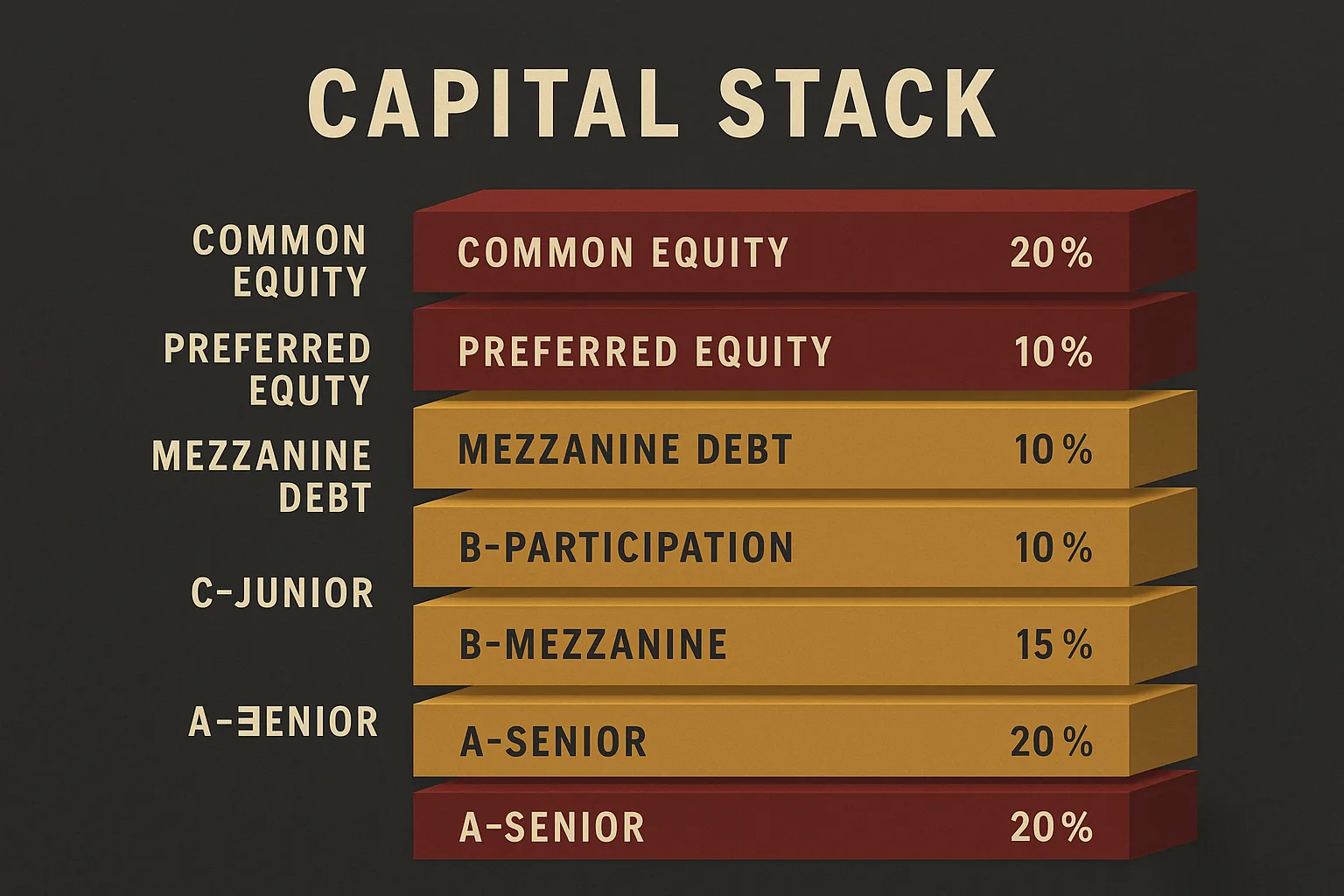
Sophisticated franchise investors don’t fund entirely from one source. They build a capital stack — multiple layers of financing with different costs, terms, and risk profiles:
| Layer | Role | Typical Amount |
|---|---|---|
| Senior debt (SBA/conventional) | Primary financing, lowest cost | $200K–$350K |
| Equipment financing | Asset-specific, secured by saunas | $60K–$120K |
| Equity injection | Your cash/liquid assets | $80K–$150K |
| Working capital reserve | Operating runway | $30K–$60K |
The goal: minimize personal asset exposure while securing enough capital to both open AND survive the 12–18 month ramp to profitability.
Option 1: SBA 7(a) — The Default Choice
Best for: Borrowers with 680+ credit, 2+ years business management experience, and 10–20% equity injection available.
| Term | Current (May 2026) |
|---|---|
| Rate | Prime + 3.0% to Prime + 4.5% (9.75%–11.25% today) |
| Term | 10 years |
| Guarantee fee | 0.25% (FY2026 simplified structure) |
| SBA guarantee | 75% of loan amount |
| Personal guarantee | Required — full amount |
| Equity injection required | 10–20% of total project cost |
| Timeline to funding | 45–90 days |
The hidden qualifier: SBA lenders for franchise loans want to see your total project cost — not just the franchise fee, but build-out, equipment, working capital, and 6 months of debt service reserves. If your total project is $450K and you have $80K liquid, many lenders want to see the full $450K covered between loan + injection. That means borrowing $370K — which pushes you into the prime + 3.0% tier.
Option 2: SBA Express — Faster, Smaller, Different Terms
Best for: Borrowers who need $150K–$350K quickly and have strong credit profiles.
| Term | SBA Express |
|---|---|
| Rate | Prime + 4.5% to Prime + 6.5% (11.25%–13.25%) |
| Max amount | $500,000 |
| SBA guarantee | 50% (vs. 75% for standard 7(a)) |
| Approval timeline | 36 hours (lender decision) |
| Funding timeline | 14–30 days |
| Documentation | Reduced — lender uses own procedures |
The tradeoff: You get speed and simplicity, but the SBA only guarantees 50%. This means lenders take more risk, charge higher rates, and may require additional collateral or a stronger personal guarantee. For a $350K Hotworx deal, Express works if you have significant additional assets the lender can collateralize — a paid-off home, investment accounts, etc.
When Express beats standard 7(a): If you’ve found a location with a landlord ready to sign and you’ll lose the space waiting 60–90 days for standard SBA processing.
Option 3: Conventional Business Loans (Non-SBA)
Best for: Borrowers with 720+ credit, significant collateral, existing banking relationships, and who want to avoid SBA personal guarantee obligations.
| Term | Conventional |
|---|---|
| Rate | 8.5%–12.5% (varies widely by lender and profile) |
| Max amount | Varies by lender |
| Government guarantee | None |
| Personal guarantee | Negotiable (sometimes limited or waived for strong borrowers) |
| Collateral | Typically requires real estate or securities |
| Timeline | 30–60 days |
Why most franchise buyers don’t qualify: Without the SBA guarantee, banks take 100% of the default risk. They respond by requiring collateral that exceeds the loan amount (125–150% coverage ratio), credit scores above 720, and either existing business revenue or substantial personal net worth.
When it makes sense: If you’re a high-net-worth individual ($2M+ liquid) buying a Hotworx franchise as a diversification play and you want to avoid the SBA’s full personal guarantee. Some conventional lenders will limit your personal guarantee to 50% of the loan or accept a partial guarantee secured only by the business assets. That’s materially different risk than SBA’s full-recourse guarantee.
Option 4: Equipment Financing (Separate from Primary Loan)
Best for: Reducing your SBA loan amount by financing infrared saunas separately.
| Term | Equipment Finance |
|---|---|
| Rate | 7.5%–14% depending on credit |
| Term | 5–7 years (matched to equipment useful life) |
| Collateral | The equipment itself |
| Personal guarantee | Sometimes limited to equipment value |
| Down payment | 0–20% |
| Timeline | 7–14 days |
The strategy: Hotworx’s infrared saunas cost $80K–$120K. If you finance these separately through an equipment lender, you reduce your SBA loan by that amount — which can drop you into a lower rate tier (loans under $250K get prime + 4.5% vs. prime + 3.0% for larger loans, but smaller loans are easier to underwrite and fund faster).
The catch: Your total monthly debt service is the same or slightly higher (equipment loans are shorter-term). But you’ve split your risk across two lenders, and the equipment loan’s personal guarantee is limited to the equipment value — not your entire net worth.
Providers to research: Balboa Capital, National Funding, currency equipment financing (franchise-specific programs).
Option 5: HELOC (Home Equity Line of Credit)
Best for: Supplementing an SBA loan with low-cost capital for working capital or equity injection.
| Term | HELOC |
|---|---|
| Rate | Prime + 0.5% to Prime + 2.0% (7.25%–8.75% today) |
| Draw period | 10 years (interest-only available) |
| Repayment | 20-year amortization after draw period |
| Collateral | Your home |
| Tax deductible | Not for business use (post-TCJA) |
| Timeline | 30–45 days |
The appeal: HELOCs offer the lowest rate of any financing option — 7.25%–8.75% vs. 9.75%–11.25% for SBA. If you have $150K in home equity available, using $80K as your equity injection and keeping $70K as working capital reserve gives you cheap runway.
The risk: You’re pledging your home to fund a franchise. If the studio fails, your home equity is at risk in addition to your SBA personal guarantee. This is precisely the kind of concentrated exposure that makes franchise failures life-altering rather than just financially painful.
The responsible maximum: Financial advisors who work with franchise investors typically recommend HELOC draws of no more than 30–40% of available equity. If you have $200K in available home equity, cap your draw at $60K–$80K.
Option 6: Investor/Partner Equity
Best for: Reducing personal capital at risk by sharing ownership.
Structures:
Silent partner (most common):
- Partner contributes 30–50% of equity injection ($40K–$75K)
- Partner receives proportional profit share (or a fixed preferred return of 8–12%)
- You maintain operational control and decision-making authority
- Franchise agreement is in your name — partner is a passive investor
Operating partner:
- 50/50 split on both capital and operational responsibility
- Reduces your total exposure by half
- But also halves your upside — $25K–$30K annual earnings per partner may not justify the time investment
The franchise agreement complication: Hotworx must approve any ownership structure. Many franchisors restrict passive investors or require all owners with 20%+ to complete training and sign the franchise agreement personally. Verify with Hotworx’s franchise development team before structuring a partnership.

Where to find franchise investors: Guidant Financial maintains a franchise investor matching network. Local angel investor groups increasingly fund franchise acquisitions. Lendesca can help you evaluate financing structures and connect with capital sources appropriate for your situation.
Option 7: Portfolio Lenders (Credit Unions and Community Banks)
Best for: Borrowers who don’t fit SBA boxes — self-employed with complex tax returns, recent career changers, those with assets but non-traditional income documentation.
| Term | Portfolio Lender |
|---|---|
| Rate | 9.0%–13.0% |
| Underwriting | Manual, relationship-based |
| Personal guarantee | Negotiable |
| Collateral | Flexible — will consider non-traditional assets |
| Timeline | 30–60 days |
| SBA guarantee | None |
How they differ: Portfolio lenders hold your loan on their own books (versus selling to secondary market). This means they can make exceptions to standard underwriting criteria. The credit union lending officer can approve a deal that would fail automated SBA underwriting — if they understand the story.
Best approached: Through introduction from a franchise-experienced CPA or attorney. Cold-calling credit unions about franchise financing rarely works — they need context and relationship.
The Decision Framework: Which Stack Fits Your Profile?
Profile A: W-2 Employee, First Business, 700+ Credit, $100K Liquid
Recommended stack:
- SBA 7(a): $280K (primary financing)
- HELOC: $50K (equity injection supplement)
- Personal savings: $50K (working capital)
- Equipment financing: $80K (infrared saunas, separate from SBA)
- Total project: $460K | Personal cash deployed: $50K
Profile B: High Net Worth ($2M+), Diversification Play, 750+ Credit
Recommended stack:
- Conventional loan: $250K (negotiated limited guarantee)
- Personal cash: $150K (equity injection + working capital)
- Equipment financing: $100K
- Total project: $500K | Personal guarantee exposure capped at $250K
Profile C: Self-Employed, Complex Returns, $200K Liquid but Non-Traditional Income
Recommended stack:
- Portfolio lender (credit union): $200K
- Personal cash: $130K
- Equipment financing: $80K
- Partner equity: $50K (silent partner, preferred return)
- Total project: $460K | Personal cash deployed: $130K
Profile D: Couple Investing Together, Combined $180K Liquid, One 680+ Credit
Recommended stack:
- SBA 7(a): $300K (stronger credit spouse as primary borrower)
- Personal savings: $100K (equity injection)
- HELOC: $60K (working capital reserve)
- Total project: $460K | No equipment carve-out (included in SBA)
What to Discuss With Your Lender
Before committing to any financing structure, bring these questions:
- “What happens to my rate if I separate equipment financing from the primary loan?” — Some SBA lenders want the full project under one roof; others prefer smaller loan amounts.
- “Can I use a HELOC draw as my equity injection?” — SBA rules require your equity injection to be “unencumbered.” Some lenders interpret HELOC draws as borrowed funds (disqualified); others allow them if the draw was taken 60+ days prior to application.
- “What’s my total personal guarantee exposure across all financing sources?” — Stack your SBA guarantee + equipment loan guarantee + HELOC lien + any partner obligations. That total number is your maximum downside.
- “What are the prepayment penalties?” — SBA 7(a) loans have prepayment penalties for the first 3 years (5%, 3%, 1% declining). Equipment loans vary. Understanding this matters if you plan to sell or refinance.
The Bottom Line
The worst financing decision is taking whatever the first lender offers without understanding alternatives. The second-worst is structuring your capital stack so that a studio failure means total financial devastation.
Build a stack that:
- Minimizes total personal guarantee exposure
- Preserves 6+ months of personal living expenses outside the business
- Doesn’t concentrate more than 40% of your net worth in a single franchise investment
- Maintains flexibility to exit without catastrophic loss
The right capital structure won’t make a bad location profitable. But the wrong one can make a good location personally devastating if the ramp takes longer than projected.
Rates as of May 2026 based on Federal Reserve prime rate of 6.75%. Individual rates depend on credit profile, collateral, and lender relationships. This is educational content, not financial advice — consult a franchise-experienced CPA and lending professional for your specific situation. Lendesca provides financing guidance for franchise and small business acquisitions. For our editorial standards and data sources, see our About page.